 Work Time
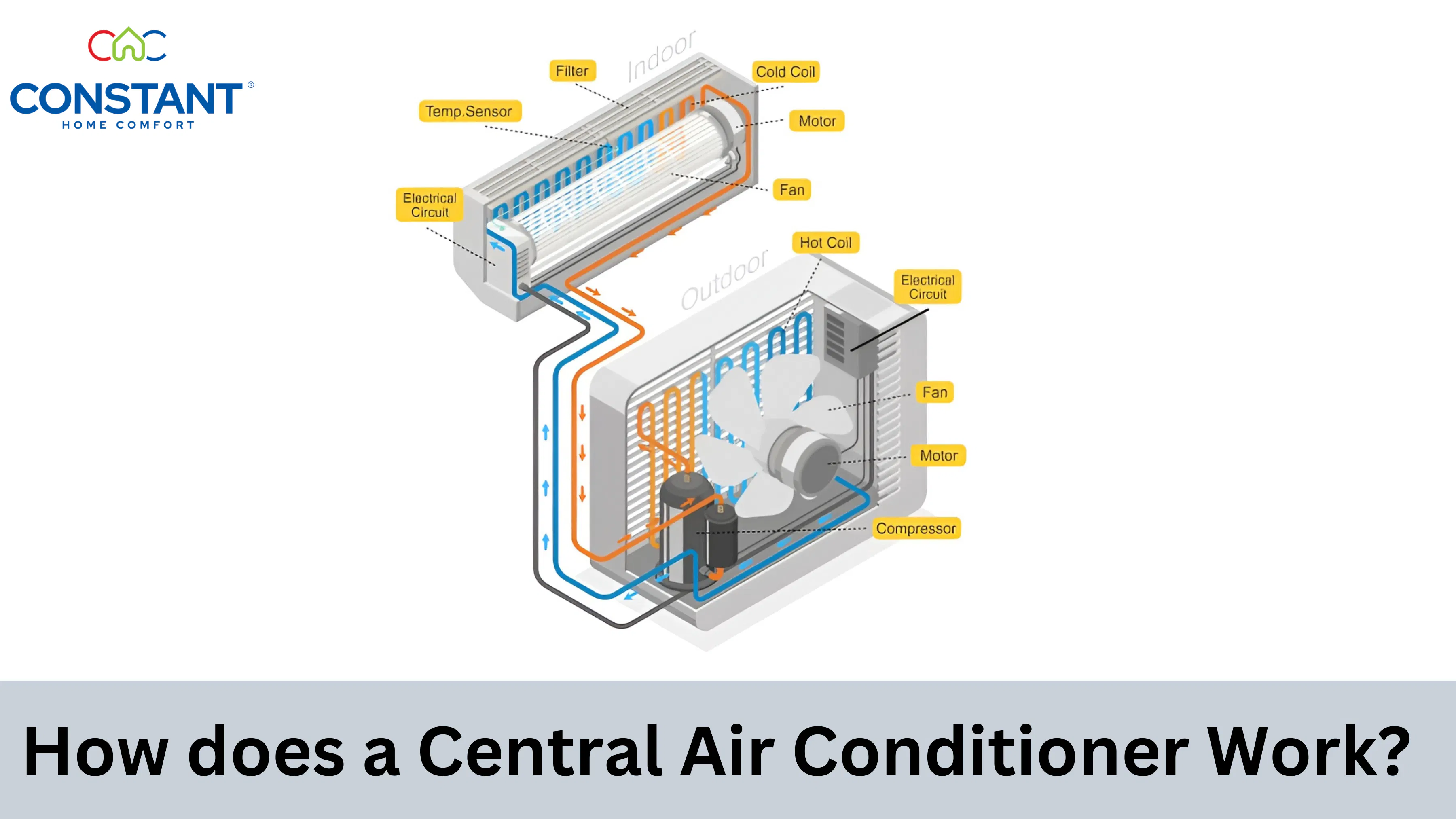
A central air conditioner is a whole-home cooling system that removes heat and humidity from your indoor air and releases it outside, distributing cooled air throughout every room of your home through a network of ducts. Unlike a window air conditioner — which is a self-contained unit that serves only the room it's installed in — a central AC system works invisibly in the background, conditioning every room through the same vents your furnace uses to heat your home in winter.
A central air conditioning system consists of two main sections:
- The outdoor unit (condenser): Installed outside your home, typically on a concrete pad beside the house. The outdoor unit houses the compressor, the condenser coil, and the condenser fan. This is where heat collected from inside your home is released to the outside air.
- The indoor unit (evaporator coil and air handler): Installed inside your home — typically mounted on top of or beside your furnace in the basement or utility room. The indoor section contains the evaporator coil through which warm indoor air passes to be cooled. The furnace blower pushes air across the evaporator coil and through your ductwork to deliver cooled air to every room.
The two sections are connected by a set of refrigerant lines that pass through the exterior wall of your home, carrying refrigerant back and forth between the indoor and outdoor units. This refrigerant is the medium through which heat energy is transferred from inside your home to the outdoors.
This is the most important concept to grasp, and it's one that surprises many homeowners. A central air conditioner does not generate cold air. It removes heat from your indoor air and transfers that heat to the outside. What's left behind after the heat is removed is cooler air — and that cooled air is what gets distributed through your vents.
The same principle applies to your refrigerator. A refrigerator doesn't make food cold by injecting coldness — it pulls heat out of the interior and releases it through the coils at the back or bottom. A central air conditioner works identically, just on a much larger scale and with your entire home as the interior being cooled.
The substance that carries heat from inside to outside is called refrigerant — a chemical compound with specific thermodynamic properties that allow it to absorb large amounts of heat at low pressure and release that heat at high pressure. The entire cooling cycle is built around moving refrigerant through a sequence of pressure changes that cause it to absorb and release heat at precisely the right points in the circuit.
The cooling cycle of a central air conditioner is a continuous loop involving four key processes: evaporation, compression, condensation, and expansion. Here is how each stage works:
Step 1 — Warm Indoor Air Passes Over the Evaporator Coil
Your furnace blower pulls warm, humid air from throughout your home through the return air ductwork and draws it across the evaporator coil in the indoor unit. The evaporator coil contains refrigerant that is at very low pressure and a correspondingly low temperature — cold enough that it readily absorbs heat from the warmer air passing over it. As the refrigerant absorbs heat from the indoor air, it evaporates from a liquid into a low-pressure gas. The air, now stripped of a significant portion of its heat, is also dehumidified in this process — moisture in the air condenses on the cold coil surface and drains away through the condensate drain line, exactly the way condensation forms on a cold glass on a warm day.
Step 2 — The Compressor Pressurizes the Refrigerant
The low-pressure refrigerant gas travels from the indoor evaporator coil through the refrigerant line to the outdoor unit, where it enters the compressor. The compressor is the mechanical heart of the air conditioning system — powered by an electric motor, it squeezes the refrigerant gas to a much higher pressure. This compression dramatically raises the refrigerant's temperature. By the time the refrigerant leaves the compressor, it is a hot, high-pressure gas carrying all the heat it absorbed from your indoor air, plus the heat added by the compression process itself.
Step 3 — The Condenser Coil Releases Heat Outdoors
The hot, high-pressure refrigerant gas flows into the condenser coil in the outdoor unit. The condenser fan draws outdoor air across the coil, and because the refrigerant is now hotter than the outdoor air, heat transfers from the refrigerant into the outside air and is carried away by the fan. As the refrigerant releases its heat, it condenses from a gas back into a high-pressure liquid. This is why you can feel warm air blowing from the outdoor unit when your air conditioner is running — that warm air is carrying the heat that was just removed from inside your home.
Step 4 — The Expansion Valve Drops the Pressure
The high-pressure liquid refrigerant now passes through an expansion valve — a small metering device that restricts flow and causes the refrigerant pressure to drop sharply. This sudden pressure drop causes the refrigerant temperature to fall dramatically, returning it to the cold, low-pressure liquid state it needs to be in to absorb heat again from your indoor air. The refrigerant then flows back into the indoor evaporator coil, and the cycle repeats continuously until your home reaches the thermostat set point.
This four-stage cycle — evaporation, compression, condensation, expansion — runs continuously while your air conditioner is operating, moving heat from inside your home to outside your home, minute by minute, on every warm day of the Ontario summer.
Compressor: The most critical component in the system, housed in the outdoor unit. Pressurizes the refrigerant to drive the heat transfer cycle. The compressor is also typically the most expensive component to repair or replace, which is why protecting it through proper maintenance and correct refrigerant charge is so important.
Condenser coil: The network of refrigerant-carrying tubes in the outdoor unit across which the condenser fan blows air to release heat to the outside. Condenser coils should be kept clean and free of debris for efficient heat rejection.
Condenser fan: Draws outdoor air across the condenser coil to carry heat away from the refrigerant. Fan motor failure causes the outdoor unit to overheat and shut down on high-pressure protection.
Evaporator coil: Located in the indoor unit, the evaporator coil is where refrigerant absorbs heat from indoor air. Evaporator coils must be kept clean — a dirty coil reduces cooling capacity, causes icing, and degrades indoor air quality.
Air handler and blower: Your furnace blower (or a dedicated air handler if you have electric heat) pushes indoor air across the evaporator coil and distributes the cooled air through your duct system to every room in the home.
Expansion valve: Controls the flow of refrigerant into the evaporator coil and causes the pressure drop that allows the refrigerant to absorb heat. Both thermostatic expansion valves (TXV) and electronic expansion valves (EEV) are used in modern systems.
Refrigerant lines: Two copper lines connect the indoor and outdoor units — a larger, insulated suction line carrying low-pressure gas from the evaporator coil to the compressor, and a smaller liquid line carrying high-pressure liquid refrigerant from the condenser back to the expansion valve.
Thermostat: The control interface that reads your home's temperature, compares it to your set point, and signals the air conditioner to turn on and off. Modern smart thermostats add scheduling, remote access, and usage data to this basic function.
Condensate drain system: Removes the moisture that condenses on the evaporator coil during cooling operation. A properly functioning condensate drain is essential — a blocked drain can cause water damage to the air handler, surrounding building materials, and finished spaces below.
Cooling and dehumidification happen simultaneously in a central air conditioner, and both contribute to your comfort. In Ontario's humid summer climate, humidity control is not a secondary benefit — it is a primary comfort factor. A home at 24°C with 70% relative humidity feels significantly more uncomfortable than a home at 24°C with 45% relative humidity.
When warm, humid indoor air passes over the cold evaporator coil, moisture in the air condenses on the coil surface — exactly the way a cold drink glass sweats in summer. This condensed moisture drips into the drain pan below the coil and flows out through the condensate drain line. The air that continues through your ducts is both cooler and drier.
A properly sized air conditioner removes humidity effectively because it runs long enough in each cycle to dehumidify the air. An oversized air conditioner cools the air too quickly, shuts off before completing adequate dehumidification, and leaves you with a home that is cool but still humid and clammy — a phenomenon known as short cycling. This is one of the most important reasons why correct sizing matters as much as equipment quality.
When comparing central air conditioners, the efficiency rating you'll encounter most often is SEER2 — Seasonal Energy Efficiency Ratio 2. SEER2 measures how much cooling output a system delivers per unit of electricity consumed over an entire cooling season, using test conditions that reflect real-world installation environments.
A higher SEER2 rating means the system delivers the same cooling for less electricity. Here is a practical reference:
- SEER2 13.4 to 15: Standard efficiency — the current minimum for new systems in Canada. Adequate performance at a lower upfront cost.
- SEER2 16 to 18: High efficiency — a meaningful step up in energy savings over a full season, with a modest price premium that is often recovered through lower hydro bills within a few years.
- SEER2 19 to 22+: Premium efficiency — the highest SEER2 ratings available on residential systems, typically achieved through variable-speed compressor technology. Maximum energy savings, quietest operation, and the best humidity control. Available on top-tier models from Lennox, Daikin, and others.
For an Ontario home running a central air conditioner through a typical cooling season of approximately 1,200 to 1,500 hours, upgrading from a SEER2 14 system to a SEER2 18 system can reduce cooling electricity costs by 20% or more annually. Over a 15-year system lifespan, that difference compounds into a substantial saving.
Note: as of January 2023, efficiency ratings in Canada shifted to the SEER2 standard, which uses test conditions more reflective of real-world installed performance. Older documentation and some contractor quotes may still reference the legacy SEER rating — a SEER2 of 13.4 is roughly equivalent to a legacy SEER of 14. When comparing systems, confirm which standard is being referenced.
One of the most meaningful technical distinctions between central air conditioner models is the type of compressor they use, and understanding this difference helps explain why premium systems perform so much better in practice.
Single-Speed (Single-Stage) Compressors
A single-speed compressor operates at one speed — full power — whenever it is running. When your home needs cooling, it turns on at 100% capacity and runs until the thermostat is satisfied, then shuts off completely. This on-off cycling is simple and reliable but carries several disadvantages: temperature swings between cycles, shorter run times that limit humidity removal, higher noise levels during operation, and energy consumption that doesn't scale down during mild weather when only a fraction of full capacity is actually needed.
Two-Stage Compressors
A two-stage compressor can operate at two output levels — typically 65% and 100% of capacity. On a mild summer day when the cooling load is modest, the system runs at the lower stage for longer, removing more humidity and maintaining more stable temperatures. It steps up to full capacity on the hottest days when maximum cooling output is needed. Two-stage systems offer better comfort and efficiency than single-stage at a moderate price premium.
Variable-Speed (Inverter) Compressors
A variable-speed or inverter-driven compressor can adjust its output anywhere across a continuous range — from as low as 25% to 100% of capacity — matching the home's actual cooling demand at any given moment. The result is a system that almost never turns completely off during a cooling cycle, instead running continuously at a low, quiet speed and modulating up and down as needed. The benefits are substantial:
- The most stable, consistent indoor temperatures of any compressor type — no perceptible temperature swings
- The most effective dehumidification — long, low-speed run times are ideal for moisture removal
- The highest efficiency ratings — variable-speed systems achieve the top SEER2 numbers available on residential equipment
- The quietest operation — running at low speed most of the time, often barely audible indoors
- The least mechanical stress on compressor components — smooth, continuous operation rather than repeated hard starts and stops
Variable-speed central air conditioners are available from Lennox, Daikin, and American Standard through Constant Home Comfort. They represent the best technology available in residential central cooling and are the clear choice for homeowners who prioritize long-term comfort, efficiency, and equipment longevity.
A central air conditioner is only as effective as the duct system that distributes its output. Even the best air conditioner will underperform in a home with a poorly maintained or designed duct system. Here are the duct factors that most affect central AC performance:
- Duct leakage: Most older Ontario homes lose 20 to 30% of conditioned air through gaps and poorly sealed duct connections before it reaches the living spaces. A system cooling effectively at the air handler may deliver significantly less cooling at the registers due to duct losses. Sealing major duct leaks is one of the highest-return efficiency improvements a homeowner can make.
- Duct sizing: Ducts that are too small for the system's airflow requirements create high static pressure, reduce airflow, and cause the evaporator coil to freeze — a symptom that looks like a refrigerant problem but is actually an airflow problem. Duct sizing is evaluated as part of a proper system design.
- Return air capacity: An adequate return air pathway — through properly sized return ducts and return grilles — is essential for the system to pull enough indoor air across the evaporator coil. Insufficient return air is a common installation oversight in older homes.
- Filter condition: The air filter protects the evaporator coil from dust accumulation. A clogged filter restricts airflow, causes the evaporator coil to freeze, reduces cooling capacity, and stresses the blower motor. Checking and replacing the filter regularly is the single most important homeowner maintenance task.
This is a question we hear frequently, and the answer is simpler than most people expect. A central air conditioner and the cooling side of a ducted heat pump use exactly the same refrigeration cycle — evaporation, compression, condensation, expansion — to move heat from inside your home to the outside. In cooling mode, they are functionally identical.
The difference is that a heat pump includes a reversing valve that allows the refrigerant circuit to operate in the opposite direction during winter — absorbing heat from outdoor air and delivering it inside as warming. A conventional central air conditioner can only move heat in one direction (out of the home) and provides no heating function.
For Ontario homeowners considering a new system, a ducted heat pump is worth serious consideration alongside a conventional central air conditioner — particularly if your furnace is also aging and due for replacement. A heat pump replaces both the furnace and the central AC in one system and typically qualifies for significant government rebates that a standalone AC does not. Constant Home Comfort can help you evaluate which approach makes the most sense for your home.
Lennox
Lennox central air conditioners lead the North American residential market in efficiency, with top models achieving SEER2 ratings of 22 or higher through their variable-speed XC25 and XC21 platforms. Lennox systems are known for exceptionally quiet operation, precise temperature control, and seamless integration with the iComfort smart thermostat. Built for reliability and long system life. The premium choice for homeowners who want the best cooling performance available.
Daikin
Daikin brings the innovation of the world's largest air conditioning manufacturer to central split systems, with ENERGY STAR certified lineups, strong variable-speed options, and outstanding reliability backed by Daikin's global manufacturing standards. Daikin central AC systems offer excellent efficiency and performance at a price point that represents outstanding value in the mid-to-premium segment.
American Standard
American Standard is a trusted North American brand with a long record of dependable central air conditioning performance. Their lineup covers standard to high efficiency, with solid SEER2 ratings, reliable two-stage and variable-speed options, and comprehensive warranty coverage. A strong choice for homeowners who want proven, durable equipment from an established brand at a competitive price.
Bosch
Bosch central air conditioning brings European engineering precision to Canadian homes, with high efficiency ratings, quiet operation, and the build quality that characterizes all Bosch HVAC products. A particularly good choice for homeowners who value engineering quality and long-term reliability.
A central air conditioner is the right choice when:
- Your home already has a furnace and a well-maintained duct system
- You want whole-home cooling delivered uniformly through existing vents
- You are replacing an aging central AC unit and your furnace is not yet due for replacement
- You prefer a fully concealed system with no visible wall units in living spaces
- You want the most established, widely serviced cooling technology available
If your home has no existing ductwork, a ductless mini-split system is likely the more practical and cost-effective cooling solution. If your furnace is also aging, a ducted heat pump that replaces both systems at once and qualifies for Ontario and federal rebates may be the better overall investment. Constant Home Comfort can walk you through all of these options at no cost or obligation.
Why is warm air blowing out of my outdoor AC unit?
This is normal and expected. The outdoor unit releases the heat that has been removed from inside your home — the warm air blowing from the outdoor unit is simply that heat being expelled to the outside. The hotter the day and the harder your system is working, the warmer that exhaust air will feel. This is a sign the system is working correctly, not a sign of a problem.
Why does my central AC feel less effective on very humid days?
Humidity dramatically affects perceived comfort. On very humid days, your air conditioner is working to remove both heat and a much higher moisture load from your indoor air. If your system is correctly sized and in good condition, it will still cool and dehumidify — it may simply need to run longer during particularly humid periods. If your home feels consistently muggy even with the AC running, the system may be oversized (short-cycling and not completing full dehumidification cycles), undersized, low on refrigerant, or have a duct issue. A service call will identify the cause.
How often should I change my air conditioner filter?
Check your filter monthly during the cooling season and replace it when it appears visibly dirty — for most households, every one to three months. Homes with pets, allergy sufferers, or high dust levels may need more frequent changes. A clogged filter is the most common and most easily preventable cause of reduced cooling performance and system damage. Use the filter type and MERV rating recommended for your specific system — overly restrictive filters can cause airflow problems even when clean.
Why is my central AC freezing up?
Ice forming on the evaporator coil or refrigerant lines is a sign that something is preventing adequate heat transfer at the indoor coil. The most common causes are a severely clogged air filter restricting airflow, a blower motor running too slowly, low refrigerant due to a leak, or a dirty evaporator coil. If you notice ice on your system, turn the AC off, let the ice melt completely with the fan running on heat mode to speed defrosting, replace the filter if it's clogged, and call us if the problem returns after the filter change.
What is the lifespan of a central air conditioner?
A quality central air conditioner that is properly sized, professionally installed, and regularly maintained typically lasts 15 to 20 years. Systems that are oversized, poorly installed, or irregularly maintained often fail significantly earlier. Annual professional maintenance — including coil cleaning, refrigerant check, and electrical inspection — is the most effective way to maximize your system's lifespan.
Does a central air conditioner use a lot of electricity?
Central air conditioning is typically one of the largest contributors to summer hydro bills in Ontario. The actual cost depends on your system's SEER2 rating, the size of your home, how many hours per day it runs, and current electricity rates. A modern high-efficiency central AC uses significantly less electricity than a system from 10 to 15 years ago — upgrading to a higher SEER2 model can reduce cooling electricity costs by 20 to 40% compared to an older unit. Proper sizing, good duct sealing, and consistent thermostat management also meaningfully reduce operating costs.
Can a central air conditioner also heat my home?
A standard central air conditioner is a cooling-only system — it cannot heat your home. Only a heat pump — which uses the same refrigeration technology but adds a reversing valve — can provide both heating and cooling. If you are interested in a single system that handles both functions, ask us about ducted heat pumps as an alternative to a conventional central air conditioner and furnace combination.
Whether you're replacing an aging central air conditioner, installing central cooling for the first time, or exploring whether a heat pump is a better fit for your home, Constant Home Comfort is here to help. Our certified technicians provide free, no-obligation in-home consultations that include a full assessment of your home, ductwork, and cooling needs — with a transparent, all-in price and a clear breakdown of all available options.
We carry Ontario's best selection of central air conditioners from Lennox, Daikin, American Standard, and Bosch — backed by our installation warranty and 24/7 ongoing service support.
Call us: 1 (888) 675-5907
Visit: constanthomecomfort.com
Serving Toronto, GTA, Hamilton, Ottawa, London, Barrie, Waterloo, Burlington, and all of Ontario.