 Work Time

Buying an air handler is one of those decisions that most homeowners only make once or twice in a lifetime — which means there’s a lot of pressure to get it right. Choose the wrong unit and you’ll spend years dealing with uneven temperatures, high energy bills, and premature breakdowns. Choose the right one and your home will be consistently comfortable for 15 to 20 years with minimal fuss.
At Constant Home Comfort, we’ve guided thousands of Ontario homeowners through this decision. This buyer’s guide reflects everything our certified HVAC technicians wish every customer knew before picking up the phone. Read it start to finish, or jump to the section most relevant to you.
Before comparing models, confirm that an air handler is what your home actually needs. An air handler is the right choice if:
- You have or are installing a heat pump as your primary heating and cooling system
- You have or are upgrading to a central air conditioner in a split system
- You want ductless mini-split heating and cooling in one or more rooms or zones
- Your existing air handler has failed and needs replacement
- Your current system is over 10–15 years old and showing signs of reduced performance
- You’re building a new home or addition without an existing furnace
If your home already has a gas furnace and you’re not adding a heat pump or central AC, you may not need a separate air handler — your furnace already has a built-in blower. Our technicians can assess your current setup at no charge and tell you exactly what your home needs. Call 1-888-675-5907.
Air handlers come in several configurations. Understanding the differences is the first major decision you’ll make.
Ducted Air Handlers
A ducted air handler connects to your home’s existing ductwork and distributes conditioned air to every room via supply and return vents. This is the most common configuration in Ontario homes built after the 1970s.
Best for: Homes with existing ductwork that are upgrading to a heat pump or central air conditioner.
Typical installation: Basement, utility closet, or attic.
Ductless Air Handlers (Mini-Split Indoor Units)
Each ductless indoor unit acts as a self-contained air handler for a single zone. There is no ductwork — the unit mounts on the wall, ceiling, or floor and delivers conditioned air directly into the room. Multiple indoor units connect to a single outdoor compressor in a multi-zone setup.
Best for: Homes without ductwork, additions, finished basements, second floors, or anyone wanting room-by-room temperature control.
Concealed Ducted Mini-Split (Slim-Duct Air Handler)
A hybrid option: a compact air handler is hidden above a ceiling or in a closet and connects to short runs of ductwork serving a specific zone. It’s nearly invisible and works well in finished spaces where wall units are not desirable.
Best for: Renovations, upscale homes, or situations where aesthetics matter and some ductwork is possible.
Makeup Air Units (Large Commercial-Style AHUs)
These large units handle 100% outside air and are typically used in commercial settings or high-ventilation residential applications. If you’re asking about this type, your HVAC contractor will guide you through specifics.
Sizing is the most commonly mishandled part of an air handler purchase — and it’s the mistake that causes the most long-term problems. An air handler that is too small won’t keep up with your home’s heating or cooling demands. An air handler that is too large will short-cycle (turning on and off rapidly), causing uneven temperatures, excess humidity, and accelerated wear.
The Right Way to Size an Air Handler: Manual J Load Calculation
The industry standard for sizing HVAC equipment is called a Manual J load calculation. A certified technician measures and inputs the following factors to determine the exact capacity your home needs:
- Square footage of the space being conditioned
- Ceiling height and number of floors
- Insulation levels in walls, attic, and basement
- Window size, type, and orientation
- Local climate data (very relevant for Ontario winters)
- Number of occupants and typical heat-generating appliances
- Ductwork condition and layout (for ducted systems)
Be cautious of any contractor who gives you a size recommendation without a proper assessment. A walk-through and square footage alone is not sufficient. At Constant Home Comfort, every installation begins with a proper evaluation of your home.
General Sizing Reference (Residential)
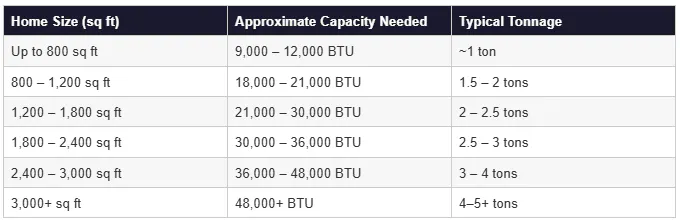
Note: These are rough estimates only. Insulation quality, climate zone, window area, and other factors will affect actual requirements significantly. Always defer to a proper load calculation.
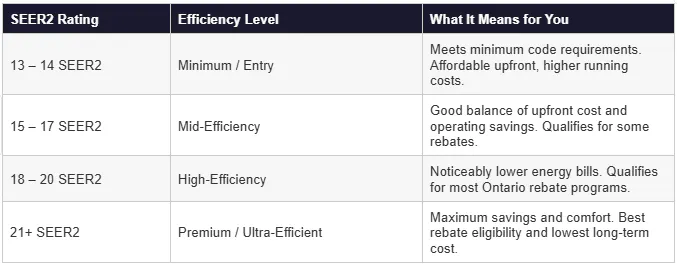
Energy efficiency ratings determine how much of the energy consumed by your system actually turns into conditioned air. Higher-rated units cost more upfront but deliver lower monthly energy bills and often qualify for larger rebates in Ontario.
SEER2 (Seasonal Energy Efficiency Ratio)
SEER2 is the primary efficiency measure for cooling. It reflects the ratio of cooling output to electrical energy consumed over a typical season. As of 2023, SEER2 replaced the older SEER standard with updated testing conditions that better reflect real-world performance.
HSPF2 (Heating Seasonal Performance Factor)
HSPF2 applies to heat pump systems and measures heating efficiency. Ontario winters make this rating especially important — a higher HSPF2 means the system produces more heat per unit of electricity, keeping your bills manageable even on the coldest days.
Look for an HSPF2 of 8.5 or higher for strong cold-climate heating performance. Many premium cold-climate heat pumps paired with modern air handlers achieve HSPF2 ratings of 10 or higher.
Variable-Speed vs. Single-Speed Blowers
The blower motor inside your air handler has a major effect on both comfort and efficiency:
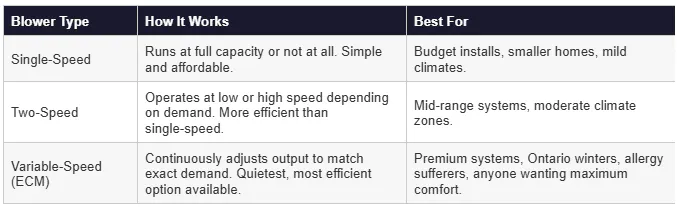
Variable-speed ECM motors are significantly quieter, reduce humidity more effectively during cooling, and can cut blower energy consumption by up to 75% compared to single-speed units. For Ontario homeowners planning to stay in their home for 5 or more years, the upgrade is almost always worth it.
Beyond size and efficiency, these are the features that will make the biggest difference in day-to-day comfort and long-term reliability:
- Coil type and quality: Look for copper or aluminum coil construction with corrosion-resistant coating, especially if your home is near the lake or in a humid environment.
- Filter compatibility: Some air handlers accept only standard 1-inch filters; others accommodate thicker 4–5 inch media filters or are compatible with HEPA or UV air purification add-ons. If indoor air quality matters to your household, this is important.
- Drain pan material: Stainless steel or double-sloped drain pans are more resistant to mold growth and corrosion than single-slope plastic pans.
- Sound rating (dB): If your air handler is installed near living spaces or bedrooms, a low sound rating matters. Variable-speed units are consistently the quietest.
- Smart thermostat compatibility: Confirm the unit is compatible with your preferred smart thermostat (Nest, Ecobee, Honeywell, etc.) for remote monitoring and scheduling.
- Zoning capability: If you want different temperatures in different parts of your home, confirm the unit supports a zoning system with motorized dampers.
- Warranty coverage: Compare parts warranties carefully. Look for a minimum 5-year parts warranty; premium units often offer 10 years or more when registered with the manufacturer.
An air handler does not work in isolation — it must be properly matched to your outdoor equipment. Mismatched systems are one of the leading causes of poor performance, premature failure, and voided warranties.
Air Handler + Heat Pump
This is the most common pairing for new Ontario installations, particularly as homeowners move away from gas and toward electrification. The air handler must be matched to the heat pump’s capacity and refrigerant type (most current systems use R-410A or the newer R-32 and R-454B). Cold-climate heat pumps that operate efficiently down to -25°C or -30°C are increasingly popular in Ontario and must be paired with compatible indoor units.
Air Handler + Central Air Conditioner
When pairing with a central AC unit, ensure the air handler’s coil is rated for the AC unit’s tonnage. Manufacturers publish matched-system lists (called AHRI-certified combinations) that guarantee rated performance when specific units are paired together. Always ask your installer to confirm the pairing is AHRI-certified.
Air Handler with Electric Heating Elements
Some air handlers include built-in electric resistance heating strips. These act as supplemental or backup heat for heat pump systems during extremely cold weather. If your home relies solely on electric heat (no gas), confirm the unit’s electric heat capacity is sufficient for your home’s heating load.
One of the most important — and most overlooked — steps in buying an air handler in Ontario is checking your rebate eligibility before you commit to a unit. Choosing a qualifying model can save you thousands of dollars and dramatically change the value equation.
Current Ontario Rebate Programs to Know
- Home Renovation Savings Program: Up to $10,600 in rebates for eligible HVAC upgrades including qualifying heat pump and air handler combinations.
- Ductless Heat Pump Rebate: Up to $5,000 for homes with electric primary heating in eligible postal codes — this can cover nearly the entire cost of a ductless mini-split installation.
- Canada Greener Homes Grant: Federal funding for high-efficiency heat pump installations, including systems with qualifying air handlers.
- Enbridge Home Efficiency Rebate: For eligible natural gas customers transitioning to high-efficiency electric systems.
- Manufacturer Promotions: Brands like Lennox periodically offer seasonal rebates and cashback promotions that stack with government programs.
Important: Rebate programs have eligibility rules, deadlines, and approved product lists. At Constant Home Comfort, we stay current on every available program and apply them to your quote automatically. You won’t miss a dollar you’re entitled to.
The unit you choose matters — but the contractor who installs it matters just as much. A poor installation can reduce a premium unit’s efficiency by 20–30% and void your manufacturer warranty. Here’s what to look for:
- Licensed and certified: In Ontario, HVAC technicians must hold a valid 313A or 313D Gas Technician certificate for gas systems and a valid refrigeration certification (Class A or B) for systems involving refrigerants. Always verify credentials.
- Performs a proper load calculation: Any reputable contractor will assess your home before recommending equipment. If they skip this step, walk away.
- Provides a written quote: Get everything in writing: equipment model numbers, installation scope, expected rebates, payment terms, and warranty details.
- Transparent about rebates: A good contractor will tell you exactly which rebates you qualify for and apply them to your price — not as an afterthought but as a core part of the quote.
- Has verifiable reviews: Check BBB, HomeStars, Google, and ReviewBuzz. Look for consistency in reviews about professionalism, punctuality, and post-installation support.
- Offers post-installation support: Will they answer the phone if something goes wrong six months from now? A 24/7 service line is a strong signal of a company that stands behind its work.
Constant Home Comfort is top-rated on BBB, HomeStars, and ReviewBuzz, and has been recognized as a premier dealer by Lennox in Canada. Our technicians are fully licensed, our quotes are transparent, and our service line is open 24/7 — 365 days a year.
Print this list and bring it to every quote appointment:
- Are you performing a Manual J load calculation for my home?
- What is the SEER2 and HSPF2 rating of the unit you are recommending?
- Is this unit AHRI-certified as a matched system with my outdoor unit?
- What rebates do I qualify for and are they already included in this quote?
- What is the full installation scope — will there be any additional charges for ductwork, permits, or electrical?
- What is the manufacturer warranty and do you handle the registration?
- What is your labour warranty on the installation?
- What maintenance will this system require and how often?
- Do you offer a maintenance or protection plan after installation?
- How quickly can you respond if there is a problem with the system after installation?
A contractor who answers all of these questions clearly and confidently, without hesitation, is one you can trust.
Buying a quality air handler is the first step. Protecting that investment through proper maintenance is what determines whether it lasts 10 years or 20. Here’s what ongoing care looks like:
- Monthly: Check the air filter and replace it if it appears grey or clogged. Households with pets or allergy sufferers may need more frequent changes.
- Every 1–3 months: Replace standard 1-inch filters. High-capacity 4–5 inch media filters may last 6–12 months.
- Annually: Schedule a professional HVAC tune-up. A technician will clean the evaporator coil, inspect the blower motor and belts, check refrigerant levels, test electrical connections, flush the condensate drain line, and verify overall system performance.
- Every 3–5 years: Have ductwork inspected for leaks, blockages, or mould (for ducted systems). Leaky ducts can reduce system efficiency by 20–30%.
- As needed: If you notice any of the warning signs covered in our related guide (unusual noises, ice buildup, water pooling, or weak airflow), call for service promptly. Early diagnosis prevents expensive repairs.
Constant Home Comfort offers annual maintenance plans and protection plans that cover both scheduled tune-ups and emergency service calls. Ask us about our current plans when you call.
Use this checklist to make sure you’ve covered every base before purchasing:
- Confirmed that an air handler is the right equipment for my home (not a furnace or standalone unit)
- Identified the correct type: ducted, ductless, or concealed ducted
- Received a proper Manual J load calculation from a licensed contractor
- Compared SEER2 and HSPF2 ratings across shortlisted models
- Checked whether variable-speed blower is available and within budget
- Confirmed AHRI-certified system matching with my outdoor unit
- Verified rebate eligibility and confirmed rebates are included in the final quote
- Reviewed the manufacturer warranty and confirmed labour warranty with installer
- Checked contractor reviews on BBB, HomeStars, and Google
- Received a written quote with full scope, model numbers, and pricing
- Confirmed financing options if applicable
- Scheduled installation date and confirmed post-installation walkthrough
How do I know if my air handler needs to be replaced or just repaired?
If your unit is under 8 years old and the repair cost is less than 30% of a replacement, repair is usually the smart call. If it’s over 12–15 years old, showing recurring issues, or your energy bills have climbed noticeably, replacement will save you more in the long run. Our technicians will give you an honest assessment with no pressure either way.
Can I use any air handler with any heat pump or AC?
No. Air handlers must be matched to your outdoor unit for capacity, refrigerant compatibility, and rated efficiency. Always confirm the pairing is AHRI-certified. Using mismatched equipment can reduce efficiency, void warranties, and cause premature failure.
What is the best air handler brand for Ontario winters?
For Ontario’s climate, we recommend brands with proven cold-weather performance and strong warranty support — Lennox, Mitsubishi, and GREE are consistently top performers. The right brand for your home depends on your system type, budget, and rebate eligibility. Our team will recommend the best match for your specific situation.
How long does air handler installation take?
Most standard installations are completed in a single day. Installations involving new ductwork, multi-zone setups, or electrical upgrades may take longer. We’ll give you a clear timeline before starting any work.
What happens if I buy an air handler that’s too big for my home?
Oversized units short-cycle — they reach the set temperature too quickly, shut off, then turn back on repeatedly. This creates humidity problems, uneven temperatures, excessive wear on components, and higher energy consumption. Proper sizing via Manual J load calculation prevents this entirely.
Does Constant Home Comfort offer maintenance plans after installation?
Yes. We offer annual maintenance plans and protection plans covering scheduled tune-ups and emergency repair service. Ask us about current plan options when you get your installation quote.
You’ve done the research. Now let our team take it from here. At Constant Home Comfort, we handle everything from load calculation and equipment selection to rebate applications, installation, and post-installation support — all backed by 24/7 service across Ontario.
Call us anytime at 1-888-675-5907 for a free, no-obligation quote. We’ll come to your home, assess your setup, and give you a real number with every applicable rebate already applied.
Serving: Toronto | Markham | Vaughan | Scarborough | Mississauga | Richmond Hill | Newmarket | Aurora | Hamilton | Ottawa | Waterloo | London | Barrie | Burlington | Durham | Kanata | and all of Ontario