 Work Time
A whole-home humidifier is one of the most low-maintenance comfort systems in your home — but low-maintenance does not mean no-maintenance. Without proper annual servicing, even the best humidifier will gradually lose efficiency, produce less moisture than your home needs, and eventually develop problems that require costly repairs or premature replacement. Constant Home Comfort's humidifier maintenance plans are designed to prevent exactly that, keeping your system clean, calibrated, and performing at its best through every Ontario heating season.
Whether you own a bypass, fan-powered, or steam humidifier, our certified HVAC technicians provide thorough, professional annual service that covers everything your unit needs to run reliably and efficiently — at a predictable, affordable cost that takes the guesswork out of humidifier ownership.
Ontario's tap water is relatively hard in many communities, meaning it contains elevated levels of dissolved calcium, magnesium, and other minerals. Every time your humidifier runs, these minerals are left behind as the water evaporates, gradually building up as scale on the water panel, the water distribution tray, the interior housing, and — in steam units — the heating element or steam canister. Over time, this mineral accumulation reduces the unit's ability to produce and distribute moisture effectively.
A water panel that was new at the start of last season may be as little as 40 to 60 percent effective by the following spring, even if no obvious problems have appeared. A humidistat that has drifted out of calibration may be reading indoor humidity several percentage points higher than the actual level, causing the system to under-run and leave your home drier than your settings suggest. A partially blocked drain line may be holding water inside the unit rather than routing it away cleanly — creating conditions that promote mould and bacterial growth.
None of these issues announce themselves loudly. They develop gradually, quietly degrading your comfort and your system's lifespan. Annual professional maintenance catches them at the earliest stage, when they are inexpensive to correct, rather than at the point of failure, when they become urgent and costly.
Every humidifier maintenance visit from Constant Home Comfort follows a comprehensive checklist developed by our certified HVAC technicians. Here is exactly what we do during each annual service appointment:
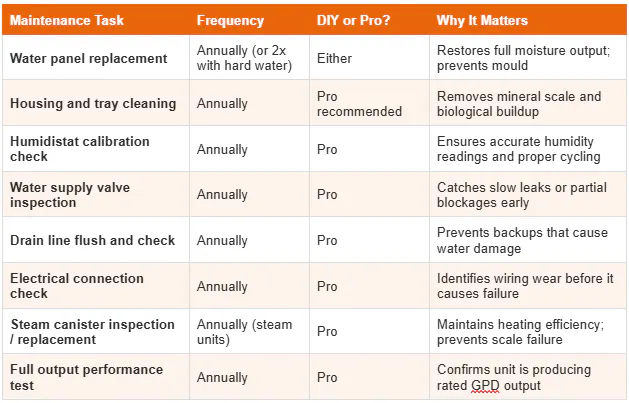
The complete maintenance visit typically takes between 45 minutes and 90 minutes depending on the type and condition of your unit. Our technician will walk you through their findings at the end of the visit, explain anything they observed that you should be aware of, and answer any questions you have about your system. If any issues are identified that require additional repair, you will receive a clear written quote before any work proceeds.
Bypass and fan-powered humidifiers share a similar maintenance process, centred primarily on the evaporator water panel and the surrounding components that manage water flow through the unit.
Water Panel Replacement
The water panel — also called an evaporator pad or media pad — is the consumable heart of a bypass or fan-powered humidifier. It is a rectangular pad made of an aluminium mesh or synthetic substrate coated with a water-absorbing material. Water flows down over the panel from a distribution bar at the top, saturating it, and warm air from the furnace passes through it, picking up moisture that is then delivered throughout your home.
Over the course of a heating season, mineral scale accumulates on the panel's surface and within its pores, progressively reducing the surface area available for evaporation. By the time a panel is visibly coated with white scale, it may be operating at a fraction of its rated capacity. Replacing the panel annually — or twice per season if your home has particularly hard water — is the single most impactful maintenance step you can take for an evaporative humidifier.
Panel replacement is a simple task, but our technicians do it as part of a broader inspection that also includes cleaning the water distribution bar to ensure even flow across the panel, inspecting the water panel housing for cracks or warping, and confirming the panel is seated correctly to prevent air bypassing around it rather than through it.
Housing and Tray Cleaning
The bottom tray of the humidifier collects excess water that drains off the water panel. Over time, this tray accumulates mineral deposits, algae, and sometimes mould if drainage is slow or inconsistent. Our technicians remove and clean the tray thoroughly, removing all scale and biological buildup, and inspect the drain line connection to confirm water is flowing away from the unit properly.
The interior of the humidifier housing is also wiped down during the maintenance visit to remove any scale or residue that has accumulated on the walls and components. This keeps the unit clean, prevents odours, and ensures that nothing inside the housing interferes with airflow or water distribution.
Solenoid Valve and Water Supply Inspection
The solenoid valve is an electrically operated valve that opens to allow water into the humidifier when the humidistat calls for humidity and closes when the target level is reached. A solenoid valve that is partially blocked by scale or beginning to fail may not open fully — restricting water flow and reducing moisture output — or may not close completely, allowing a slow trickle of water that can lead to flooding of the distribution tray and drain line.
Our technician will test the solenoid valve for proper operation, inspect the water supply line for any signs of restriction or corrosion, and confirm that the shutoff valve is accessible and functioning in case of an emergency.
Steam humidifiers require a slightly different maintenance approach compared to evaporative models. Because they boil water to produce steam, the components that handle water and heat are subject to more intense mineral buildup and require careful inspection and timely replacement.
Steam Canister Inspection and Replacement
The steam canister — also called the steam cylinder — is the component inside a steam humidifier that holds water and contains the heating elements that boil it into steam. As the canister operates, minerals from the water gradually coat the interior surfaces and the electrodes that conduct electricity to heat the water. When scale buildup becomes heavy enough, the canister's efficiency drops, it takes longer to produce steam, and eventually it fails to function at the rated output level.
During a maintenance visit, our technician will inspect the steam canister for scale buildup and assess whether it is approaching the end of its effective life. Depending on your water hardness and how heavily the humidifier has been used during the season, the canister may need cleaning or replacement. We carry commonly needed canisters for major steam humidifier brands and can perform replacement on the same visit in most cases.
Steam Distributor and Duct Connection Inspection
Steam humidifiers inject steam directly into the air handler or duct system through a steam distributor — a perforated tube or manifold installed inside the duct. Over time, mineral deposits can accumulate on the distributor and partially block the steam outlets, reducing steam delivery efficiency and potentially creating conditions where condensation forms inside the duct. Our technician will inspect and clean the distributor as part of the maintenance visit to ensure steam is being delivered evenly and efficiently.
Control Board and Sensor Testing
Steam humidifiers include more sophisticated electronic controls than evaporative models — typically a control board that manages the heating cycle, monitors water level, and communicates with the humidistat. Our technician will run a full operational test of the control system, checking that the water level sensor is reading correctly, that the heating cycle is activating and deactivating as expected, and that all safety controls are functioning. Any error codes stored in the control board will be identified and addressed.
For most Ontario homeowners, a single annual maintenance visit — scheduled at the beginning of the heating season, ideally in September or October — is the right cadence. Completing the service before the heating season begins ensures your humidifier is clean, calibrated, and fully ready to perform from the first cold day of fall through the last cold day of spring.
There are situations where more frequent servicing makes sense. Homes with very hard water — areas where scale buildup on faucets and showerheads is visible and rapid — may benefit from a mid-season water panel replacement in addition to the annual service visit. Steam humidifier owners in hard-water areas may need canister replacement more than once per season depending on usage volume. If you are unsure how hard your water is, your technician can assess scale buildup during the first maintenance visit and recommend an appropriate service frequency going forward.
Homes where a family member has asthma, allergies, or a compromised immune system may also benefit from more frequent cleaning to ensure the humidifier components remain free of any biological growth that could affect indoor air quality. Our team will help you establish the right schedule based on your home's specific conditions.
Constant Home Comfort offers humidifier maintenance as a standalone annual service or as part of a comprehensive HVAC maintenance plan that covers your furnace, air conditioner, and humidifier together. Here is how the options compare:
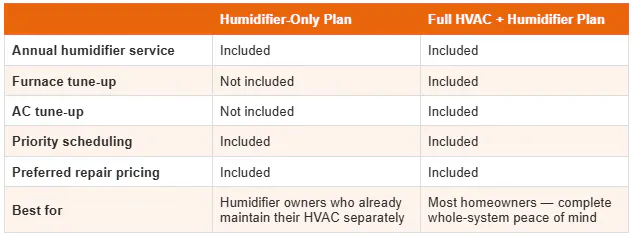
Our maintenance plan members also receive priority scheduling — meaning that if you need a repair during the heating season, you are moved to the front of the queue ahead of non-plan customers. During Ontario's peak heating months, when service demand is highest, this can mean the difference between a same-day repair and a multi-day wait. Plan members also receive preferred pricing on any parts and labour required for repairs identified during or between maintenance visits.
Speak with our team about current plan pricing and availability. We offer flexible payment options and can enroll you at any time of year — even mid-season if your humidifier has not been serviced recently and you want to get it back to peak condition right away.
Some homeowners delay or skip annual maintenance to save money in the short term. The numbers rarely support this decision when you account for the full picture.
A water panel that is not replaced annually may reduce moisture output enough that your home remains dry and uncomfortable despite the humidifier appearing to run normally. The practical result is often that the homeowner turns up the thermostat to compensate for the cold, dry feeling — increasing heating costs. Over a full season, the energy cost of running the furnace harder to offset the discomfort of dry air can easily exceed the cost of the maintenance visit itself.
Scale buildup that is left unaddressed accelerates wear on the solenoid valve, the water distribution components, and — in steam units — the heating element and control board. Components that fail due to neglected maintenance typically do so at the worst possible time: mid-winter, on a weekend, or during a cold snap when service demand is at its highest and response times are longest. The cost of an emergency repair call, which includes after-hours labour rates in addition to parts, almost always exceeds several years' worth of preventive maintenance costs.
Most importantly, a whole-home humidifier is designed to last ten to fifteen years when properly maintained. Skipping annual service consistently can cut that lifespan in half, meaning you pay for a new installation years earlier than necessary. The math consistently favours maintenance.
While we strongly recommend annual professional maintenance, there are several simple tasks homeowners can do themselves between service visits to help keep their humidifier running well throughout the season.
The most impactful DIY task is monitoring the humidistat setting and adjusting it as outdoor temperatures change. During very cold weather — minus 15°C or colder — reducing the humidity setpoint to 30% to 35% helps prevent condensation from forming on windows and exterior walls. As temperatures moderate in spring, you can gradually increase the setting back toward your preferred level of 40% to 50%.
Periodically checking that the area around the humidifier is dry and free of water stains is also worthwhile. A small drip or puddle near the unit is an early warning sign of a drain line issue or a failing solenoid valve — catching it early means a minor repair rather than water damage to surrounding equipment.
If your humidifier has a visible water panel, you can visually inspect it mid-season to assess scale buildup. A panel that is heavily coated with white or grey mineral deposits before the season is half over may warrant an early replacement to maintain performance through the coldest months. Replacement panels are inexpensive and widely available for most popular models.
Everything beyond these basic checks — calibrating the humidistat, inspecting electrical connections, testing solenoid valve operation, cleaning the internal housing, and flushing the drain line — is best left to a trained technician with the right tools and experience. Attempting these tasks without proper knowledge can result in water damage, electrical issues, or inadvertently voiding the unit's warranty.
Do not wait until your humidifier stops working to think about maintenance. The best time to schedule your annual service is before the heating season begins — when our technicians have more scheduling flexibility and you have the peace of mind of knowing your system is ready for the months ahead.
Constant Home Comfort provides humidifier maintenance across Toronto, the GTA, Hamilton, Ottawa, Barrie, London, Waterloo, and communities throughout Ontario. Our certified technicians arrive on time, work efficiently, and leave your system in better condition than they found it. Every maintenance visit comes with a written summary of the work completed and the condition of your unit, so you always have a clear record of your system's service history.
Call us today to schedule your annual humidifier service, ask about our maintenance plan options, or get answers to any questions you have about keeping your whole-home humidifier performing at its best.
Call us at 1 (888) 675-5907 or book your appointment online at constanthomecomfort.com