 Work Time
If you're shopping for a home ventilator in Ontario, you already know fresh air matters — but what does it actually cost? Ventilator pricing varies widely depending on the type of unit, your home's size, existing ductwork, and the complexity of the installation. This guide breaks it all down so you can compare options clearly and budget confidently.
At Constant Home Comfort, we believe you deserve transparent pricing and honest advice — no guesswork, no surprises. Whether you're comparing an HRV to an ERV or trying to understand what's included in an installation quote, you'll find everything you need right here.
The table below shows typical fully installed price ranges for HRV and ERV ventilators in Ontario, including the unit and standard installation. Prices reflect market rates as of 2026.
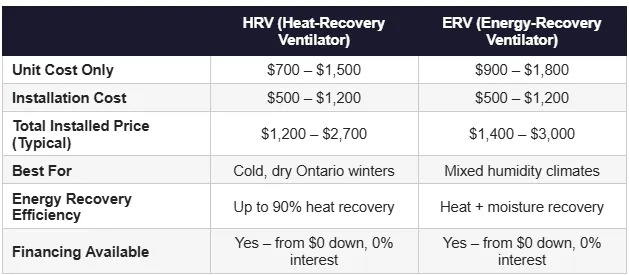
* Price ranges are estimates for Ontario homeowners and may vary based on home size, installation complexity, and brand selected. Contact us for an exact quote.
A properly quoted ventilator installation from a reputable company should include all of the following. If a quote seems unusually low, it's worth asking what's not included.
- The ventilator unit itself (HRV or ERV, sized appropriately for your home)
- Ducting and connections to your existing forced-air system or dedicated ventilation ducts
- Intake and exhaust hoods mounted on an exterior wall, with proper insulation and sealing
- Electrical wiring and controls including wall control or timer if applicable
- Airflow balancing to ensure equal intake and exhaust and optimal performance
- Clean-up and inspection before the technician leaves
- Manufacturer warranty registration on your behalf
At Constant Home Comfort, all of the above is included in every installation — and we also help identify any available government rebates to reduce your out-of-pocket cost.
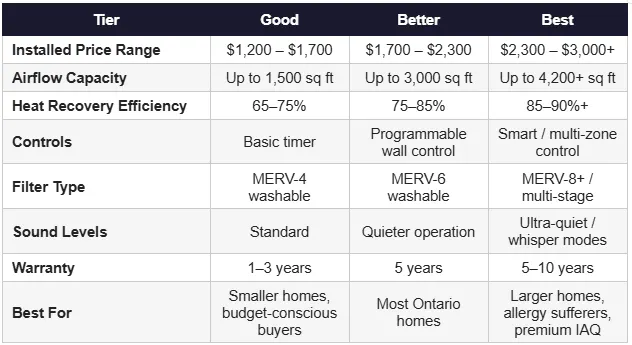
Just like furnaces and air conditioners, home ventilators come in different tiers. Here's how to think about each level and what you get for your investment:
Several variables influence your final installation quote. Understanding these upfront prevents surprises and helps you ask the right questions when getting estimates.
1. Home Size and Layout
Larger homes require a higher-capacity unit and more ductwork, both of which add to cost. A 4,200 sq ft home will need a unit with greater airflow capacity than a 1,200 sq ft condo — and the installation will be more complex.
2. Existing Ductwork
Homes with existing forced-air ducting are generally less expensive to connect. If your home has no ductwork (common with boiler or radiant heat systems), additional dedicated ventilation ducts will need to be installed, adding to the overall cost.
3. Unit Type: HRV vs. ERV
ERVs typically cost $200–$500 more than an equivalent HRV unit due to the additional moisture-transfer membrane. However, for the right home and climate, the added humidity management can reduce wear on other HVAC equipment and improve year-round comfort significantly.
4. Brand and Efficiency Rating
Premium brands like Lennox offer higher efficiency ratings, longer warranties, quieter operation, and more advanced controls. While the upfront cost is higher, the long-term energy savings and durability often make premium units the better value over a 10–15 year lifespan.
5. Accessibility and Installation Complexity
If your mechanical room is easy to access and close to an exterior wall, installation is straightforward. Tight crawlspaces, long duct runs, or complicated venting paths can add labour time and cost. A site assessment before quoting is the best way to get an accurate number.
6. Controls and Accessories
Basic wall timers are usually included in the base price. Programmable controls, dehumidistats, or smart home integration are optional accessories that add value — and cost. Ask your installer which controls are included and which are add-ons.
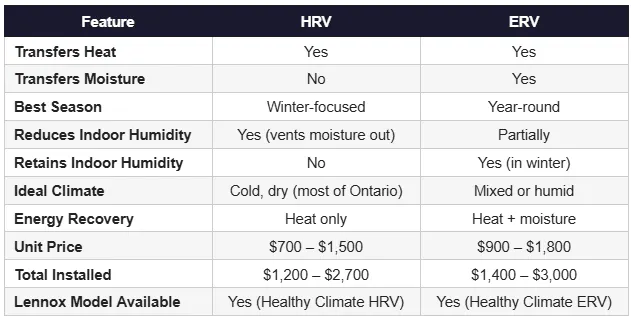
Not sure which type of ventilator is worth the investment for your situation? Here's a detailed side-by-side comparison:
The actual out-of-pocket cost of a new ventilator can be meaningfully reduced through available rebate programs. Constant Home Comfort handles the paperwork for you, but here's what to know:
- Home Renovation Savings Program (HRSP): Ontario homeowners may qualify for rebates on eligible HVAC and IAQ upgrades. Ventilators installed as part of a broader home improvement project can qualify.
- Enbridge Home Efficiency Rebates: Eligible Enbridge Gas customers may receive rebates on qualifying ventilation equipment when installed to improve whole-home energy efficiency.
- Canada Greener Homes Loan: Interest-free financing of up to $40,000 for eligible energy efficiency retrofits may apply when a ventilator is installed alongside other qualifying upgrades.
- Manufacturer Promotions: Lennox periodically offers seasonal rebates on HRV and ERV units. Ask us about current promotions when you call.
Rebate eligibility depends on your postal code, existing equipment, and the specific program in effect at the time of installation. Our team will confirm which programs apply to you before any work begins.
You don't have to pay the full cost upfront. Constant Home Comfort offers flexible financing options that make it easy to get the ventilator your home needs — without waiting. Options include:
- $0 down, 0% interest for 12 months (O.A.C.) — get your system installed today and spread the cost interest-free
- Low monthly payment plans available for longer terms, making even premium units accessible on any budget
- Quick approval process — apply in minutes, get an answer the same day
When you combine financing with available rebates, many Ontario homeowners find that their ventilator effectively pays for itself in energy savings within 5–8 years — all while improving their family's health from day one.
For most Ontario homeowners, the answer is yes — especially in tightly built modern homes or older homes that have been air-sealed for energy efficiency. Here's the financial case in plain terms:
- Energy savings: By recovering up to 90% of the heat in exhaust air, an HRV or ERV reduces your furnace's workload — translating to 10–20% lower heating costs in winter depending on your home's air leakage rate.
- Moisture damage prevention: Excess indoor humidity causes mould, wood rot, and paint failure. Proper ventilation can prevent thousands of dollars in future repair costs.
- Health benefits: Improved indoor air quality reduces sick days, allergy symptoms, and respiratory issues — a benefit that's difficult to put a dollar figure on but is very real for Ontario families.
Home resale value: A properly ventilated home with documented IAQ improvements is a selling feature that modern buyers — especially post-pandemic — actively look for.
How much does an HRV cost to run per month?
Most residential HRV units consume between 30 and 100 watts of electricity depending on the fan speed and model — roughly equivalent to a standard light bulb. At Ontario electricity rates, running your HRV continuously adds approximately $3–$10 per month to your electricity bill, which is far outweighed by the heating energy it saves.
Can I install a ventilator myself to save money?
We strongly recommend against DIY installation. Improperly installed ventilators can cause negative air pressure, backdrafting of combustion appliances (like your furnace or water heater), moisture intrusion, and voided warranties. Professional installation ensures the system is safely integrated with your home's HVAC and performs as designed.
Does a ventilator replace the need for bathroom exhaust fans?
In many cases, an HRV or ERV can be connected to serve as the primary exhaust for bathrooms, eliminating the need for separate exhaust fans — and doing so more efficiently, since the heat is recovered rather than wasted. Ask your installer about integrated bathroom exhaust as part of your design.
How long does ventilator installation take?
Most standard HRV or ERV installations are completed in one day — typically 4 to 8 hours. More complex installations involving new ductwork may require a second visit. We provide a realistic timeline estimate during your in-home assessment.
What's the difference between a quote from a big box retailer and Constant Home Comfort?
Big box store installations are often subcontracted to third-party crews, with less accountability and limited post-installation support. At Constant Home Comfort, our certified technicians perform every installation, rebate assistance is included, and our 24/7 support team is a phone call away if anything ever comes up.
Price ranges are useful for planning, but the only way to know exactly what a ventilator will cost for your home is a proper assessment. Our team will evaluate your home, recommend the right unit and tier, confirm your rebate eligibility, and give you a firm quote — all in one visit, at no cost to you.
Constant Home Comfort serves homeowners across the GTA, Hamilton, Ottawa, London, Waterloo, Windsor, and all of Ontario. Call us 24/7 or submit a request online — we typically schedule assessments within 1–2 business days.
Call 1 (888) 675-5907 | Free In-Home Assessment | No Obligation