 Work Time

Buying crawl space insulation isn't as simple as picking up a few rolls of fibreglass from the hardware store and stapling them in place. Done wrong, it can make your moisture problem worse, trap mold behind insulation panels, or leave major thermal gaps that defeat the whole purpose. Done right, it's one of the highest-return comfort upgrades you can make to an Ontario home — reducing your heating bills, eliminating cold floors, and protecting your home's structure for decades.
This guide walks you through everything you need to know before buying crawl space insulation: how to assess your crawl space, which insulation type fits your situation, what R-value you should be targeting in Ontario, and what to watch for when comparing contractors and quotes.
Whether you're doing your homework before calling us or just want to understand your options, this is the most complete resource available for Ontario homeowners.
The single most important decision in any crawl space insulation project is not which material you use — it's understanding what type of crawl space you have. Getting this wrong leads to wasted money, moisture problems, and insulation that underperforms from day one.
There are two fundamental crawl space configurations in Ontario homes, and they require completely different insulation approaches:
Vented (Unconditioned) Crawl Space
A vented crawl space has foundation vents that allow outdoor air to circulate through the space. Because outside air (and outside temperatures) can freely enter, the crawl space itself is not part of your home's conditioned thermal envelope.
In a vented crawl space, insulation belongs between the floor joists — directly under your living space floors. The goal is to create a thermal barrier between the cold crawl space air and your warm living areas above. The crawl space itself stays cold in winter; you are only protecting the floor above it.
- Insulation placement: Between floor joists, under the subfloor
- Best materials: Fibreglass batt, mineral wool batt, rigid foam board
- Vapour barrier: Required on the ground to manage ground moisture
- Key risk: If batts are installed without a ground vapour barrier, rising moisture saturates the insulation and creates mold
Conditioned (Sealed) Crawl Space
A conditioned crawl space is sealed — foundation vents are closed or eliminated, and the space is brought inside your home's thermal envelope. Insulation is applied to the perimeter walls and rim joists rather than the floor above. The crawl space stays closer to indoor temperatures year-round.
This approach is more energy-efficient overall, better protects pipes and ducts running through the crawl space, and eliminates the moisture problems associated with vented designs. It is the preferred method in newer Ontario construction and a recommended upgrade for older homes.
- Insulation placement: Foundation walls and rim joists
- Best materials: Closed-cell spray foam, rigid foam board (with spray foam at seams)
- Vapour barrier: Sealed to both floor and walls continuously
- Key advantage: Pipes, ducts, and structural members stay in conditioned space — no freezing, no sweating
If you are unsure which type of crawl space you have, the easiest way to find out is to look for vents in your foundation walls. If you can see vents to the outside, you have a vented crawl space. No foundation vents (or vents that have already been sealed) typically indicate a conditioned setup — though many Ontario homes are mid-conversion with partial sealing.
Our team at Constant Home Comfort inspects your crawl space as part of every free quote — so you always know exactly what you're working with before any buying decisions are made.
Buying insulation before assessing your crawl space is one of the most common and costly mistakes Ontario homeowners make. Installing new insulation over existing moisture damage, mold, or inadequate vapour barriers is a waste of money — and it can accelerate structural deterioration.
Before any insulation purchase or installation, evaluate the following:
Check for Existing Insulation
Many Ontario homes — particularly those built before 1980 — have degraded, sagging, or completely missing crawl space insulation. Old fibreglass batts often fall out of floor joist cavities over time, compressed batts lose their R-value, and some older homes were never insulated below the floor at all.
- Look for batts that are sagging, wet-looking, discoloured, or have fallen to the ground
- Check for visible gaps between batts and the surrounding joists
- Note if any insulation has been disturbed by pest activity
- If insulation is present but damaged, it must be removed before re-insulating
Inspect for Moisture and Mold
Moisture is the most destructive force in any crawl space. In Ontario's climate — where significant temperature swings cause repeated condensation cycles — ground moisture and airborne humidity can wreak havoc on unprotected crawl spaces.
- Look for standing water, water stains on the concrete, or soil that appears dark and damp
- Check wood joists and the subfloor above for discolouration, soft spots, or white fuzzy growth (mold or mildew)
- A musty smell coming from lower levels of your home is a reliable indicator of active moisture problems
- Any mold discovered must be professionally remediated before insulation is installed — not after
Evaluate Your Vapour Barrier
If your crawl space already has a ground-level vapour barrier (a sheet of polyethylene plastic covering the soil), check its condition. Barriers can be torn, inadequately sealed at edges and seams, or too thin (anything under 6 mil is considered insufficient by modern Ontario standards).
- A compromised vapour barrier is nearly as bad as no barrier at all
- Full replacement or repair is typically required when re-insulating
- In conditioned crawl spaces, the barrier must extend up the walls and seal against the foundation — not just cover the floor
Note Your Access Points
Crawl space access difficulty directly affects both your project cost and the feasibility of certain insulation methods. Very low ceiling heights, obstructions, or a single small hatch can limit what a contractor can practically install and how long it takes. Note the height of your crawl space, the width of access points, and any structural obstacles like pipes, ducts, or posts.
Once you understand your crawl space type and current conditions, you can make an informed decision about insulation material. Here is how each option stacks up for Ontario's climate:
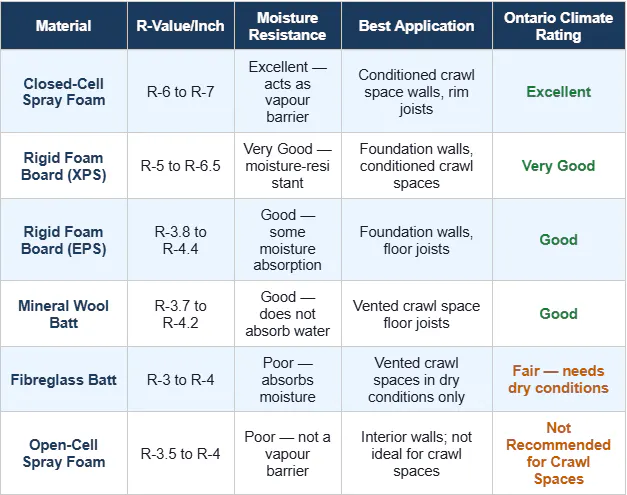
* Ontario Climate Rating reflects suitability for cold winters, seasonal humidity swings, and ground moisture levels typical across the GTA and surrounding regions.
R-value measures thermal resistance — how well an insulation material slows heat transfer. In Ontario's climate zone (primarily Zone 6 and Zone 7), higher R-values are strongly recommended for crawl spaces, particularly in homes that rely on their furnace heavily in winter.
The Ontario Building Code sets minimum standards, but minimum is not the same as optimal. Here are the recommended targets for Ontario crawl space insulation:
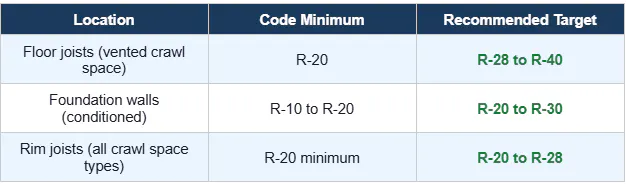
* Target R-values reflect best-practice recommendations for Ontario climate conditions and may exceed current code minimums. Higher R-values improve rebate eligibility and long-term energy savings.
Keep in mind that R-values are additive — if you have 3 inches of closed-cell spray foam on your foundation walls (approximately R-18 to R-21), adding an inch of rigid foam board as a secondary layer can push you to a target R-value without a full re-spray. Discuss layering options with your insulation contractor.
Two elements that are non-negotiable in any Ontario crawl space insulation project — yet frequently overlooked in DIY attempts and low-budget installs — are the vapour barrier and air sealing.
The Vapour Barrier
Ground moisture is a constant threat in Ontario crawl spaces. Soil releases water vapour continuously, especially in spring and during rain-heavy seasons. Without a vapour barrier, this moisture rises into your insulation and structural members, degrading performance and accelerating rot and mold growth.
A proper vapour barrier should meet the following standards:
- Minimum 6 mil polyethylene sheeting — heavier (10 mil or 20 mil) is preferable for conditioned crawl spaces
- Lapped and taped at all seams — not just loosely overlapped
- Secured at the perimeter to the foundation wall — not just left loose at the edges
- In conditioned crawl spaces: extended up the walls and sealed with appropriate adhesive or tape
- In vented crawl spaces: covering 100% of the exposed ground with no gaps
Air Sealing
Air sealing addresses the gaps, cracks, and penetrations through which cold outside air infiltrates your crawl space and living areas. The most critical locations to seal in any Ontario crawl space are:
- Rim joists — where the floor system meets the foundation wall; this is the single largest air leakage point in most crawl spaces
- Pipe and wire penetrations through the subfloor
- Gaps between the sill plate and foundation wall
- Foundation vent openings (in conditioned crawl space conversion)
- Cracks in the foundation walls
Closed-cell spray foam handles both insulation and air sealing simultaneously at rim joists, which is why it remains the top recommendation for this critical location even when another material is used elsewhere in the crawl space.
When comparing quotes from contractors, not all proposals cover the same scope of work. A low quote that excludes vapour barrier replacement, air sealing, or old insulation removal is not a true apples-to-apples comparison with a comprehensive quote that includes all of these.
A complete, properly scoped crawl space insulation project in Ontario should include:
- Initial inspection — assessment of existing conditions, moisture levels, current insulation, and vapour barrier status
- Old insulation removal — if existing insulation is damaged, moldy, compressed, or inadequate
- Mold remediation — if discovered during inspection, this must be addressed before new insulation is installed
- Air sealing — particularly at rim joists, pipe penetrations, and foundation cracks
- Vapour barrier installation or replacement — full-coverage polyethylene sealed at seams and perimeter
- Insulation installation — appropriate material for your crawl space type and target R-value
- Final inspection and documentation — confirms installed R-value and vapour barrier coverage, required for rebate applications
When you receive a quote from Constant Home Comfort, every one of these steps is reviewed and accounted for in our proposal. We never recommend a scope of work that leaves out a critical component just to appear cheaper at first glance.
Before you finalize your buying decision, know your financial options. Ontario homeowners may be eligible for crawl space insulation rebates through programs such as the Home Renovation Savings Program, Enbridge Home Efficiency Rebates, and other provincial or federal incentives active at the time of installation.
Stacking Rebates for Maximum Savings
One of the smartest buying strategies for Ontario homeowners is to combine crawl space insulation with other rebate-eligible upgrades — particularly a heat pump installation. When paired together, these upgrades unlock stacked rebates that significantly reduce the total investment across both projects.
- Heat pump + crawl space / basement header insulation: $1,900 – $2,900 combined rebate potential
- Heat pump + attic insulation: $2,500 – $4,100 combined rebate potential
- Multiple insulation upgrades together can qualify for additional program tiers
$0 Down, 0% Interest Financing
Constant Home Comfort offers $0 down, 0% interest financing on approved credit — meaning you can complete your crawl space insulation project today and pay over time in manageable monthly installments. This option is available alongside applicable rebates, further reducing the net out-of-pocket cost of your project.
We Handle All the Paperwork
Navigating government rebate programs can be confusing and time-consuming. Our team manages every application on your behalf — verifying eligibility, preparing documentation, and submitting everything at no extra cost to you. You get the rebate; we do the work.
The quality of your crawl space insulation project depends as much on the contractor you choose as the materials specified. Here is what to look for — and what to watch out for:
What a Good Contractor Does
- Inspects your crawl space in person before quoting — never provides a price based on square footage alone
- Identifies and communicates any moisture, mold, or structural issues discovered during inspection
- Specifies exact materials, thicknesses, and R-values in writing before work begins
- Includes vapour barrier and air sealing in the scope — not as optional add-ons
- Provides documentation of installed R-values for rebate applications
- Is registered with active Ontario rebate programs and can apply on your behalf
- Offers a clear warranty on both materials and workmanship
Red Flags to Watch For
- Quotes provided over the phone without a site inspection
- No mention of vapour barrier or air sealing in the proposal
- Pressure to sign immediately or accept a "today only" price
- No written scope of work — only a verbal agreement on price
- No documentation of installed R-values or photos of completed work
- Cash-only payment requests with no invoice or receipt
Constant Home Comfort has served Ontario homeowners for years with fully transparent quotes, written scopes of work, and a track record of five-star reviews across the GTA and beyond. We never ask you to commit before you fully understand what you are getting.
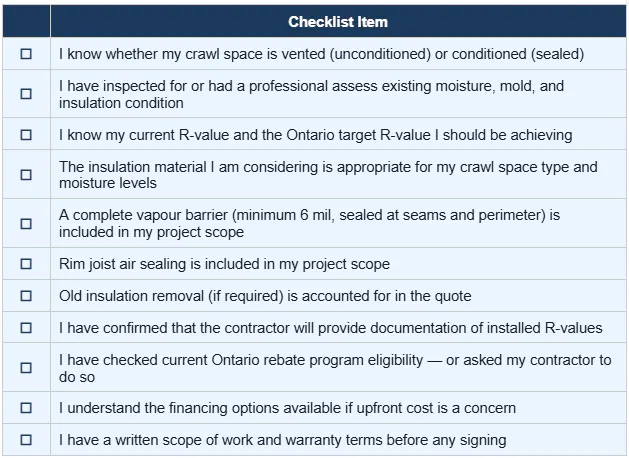
Use this checklist before finalizing any crawl space insulation purchase or contractor selection:
Should I insulate my crawl space floor or walls?
It depends on your crawl space type. In a vented (unconditioned) crawl space, insulate between the floor joists above — the floor is your thermal boundary. In a conditioned (sealed) crawl space, insulate the foundation walls and rim joists instead, bringing the space inside your home's thermal envelope. Installing wall insulation in a vented crawl space, or floor joist insulation in a conditioned one, will not give you the results you expect.
Can I insulate my crawl space myself?
Some homeowners attempt DIY crawl space insulation using fibreglass batts, and while it is physically possible, it is rarely advisable in Ontario. The most common DIY mistakes — inadequate vapour barriers, incomplete air sealing, wrong material for crawl space type, and failing to address pre-existing moisture — can cost far more to correct than a professional install would have. Professional installation also ensures documented R-values, which are required for rebate applications.
What is the best insulation for a crawl space in Ontario?
For conditioned (sealed) crawl spaces: closed-cell spray foam on rim joists combined with rigid foam board on foundation walls is the highest-performing system for Ontario's climate. For vented crawl spaces: mineral wool batt in floor joists with a 6 mil vapour barrier on the ground is a reliable and cost-effective approach. The best choice always depends on your specific crawl space conditions.
How do I know if my crawl space insulation is failing?
Common signs of failing crawl space insulation include persistently cold floors in winter, unexplained increases in heating or cooling bills, musty smells in lower levels of your home, visible moisture or condensation in the crawl space, sagging or discoloured batts, and visible mold on wood surfaces. If you notice any of these, contact a professional for an inspection before the problem worsens.
How long does crawl space insulation last?
Spray foam and rigid foam board can last 25 years or more with minimal degradation. Fibreglass and mineral wool batts typically last 15 to 20 years in ideal conditions, but can fail much sooner in damp crawl spaces without a proper vapour barrier. Regular inspection (every 3 to 5 years) is recommended to catch any early signs of moisture infiltration or pest damage before they compromise the system.
The best crawl space insulation decision starts with an accurate picture of what you are actually working with — and that means a proper in-person inspection before any material or method is chosen. Constant Home Comfort provides free crawl space inspections and fully transparent quotes across Ontario, with no pressure and no obligation.
Our team will identify your crawl space type, assess current conditions, recommend the right insulation system for your home and budget, and apply every available rebate to your project. We handle installation, vapour barrier, air sealing, documentation, and rebate applications — everything, under one roof.
Call Now: 1-888-675-5907 | Available 24/7 for quotes and service.
Or use our online contact form to book your free crawl space inspection — we'll be in touch within one business day.
Service Areas: Toronto | GTA | Hamilton | London | Ottawa | Waterloo | Barrie | Vaughan | Markham | Scarborough | Richmond Hill | Newmarket | Mississauga | Durham | Burlington | Kanata