 Work Time
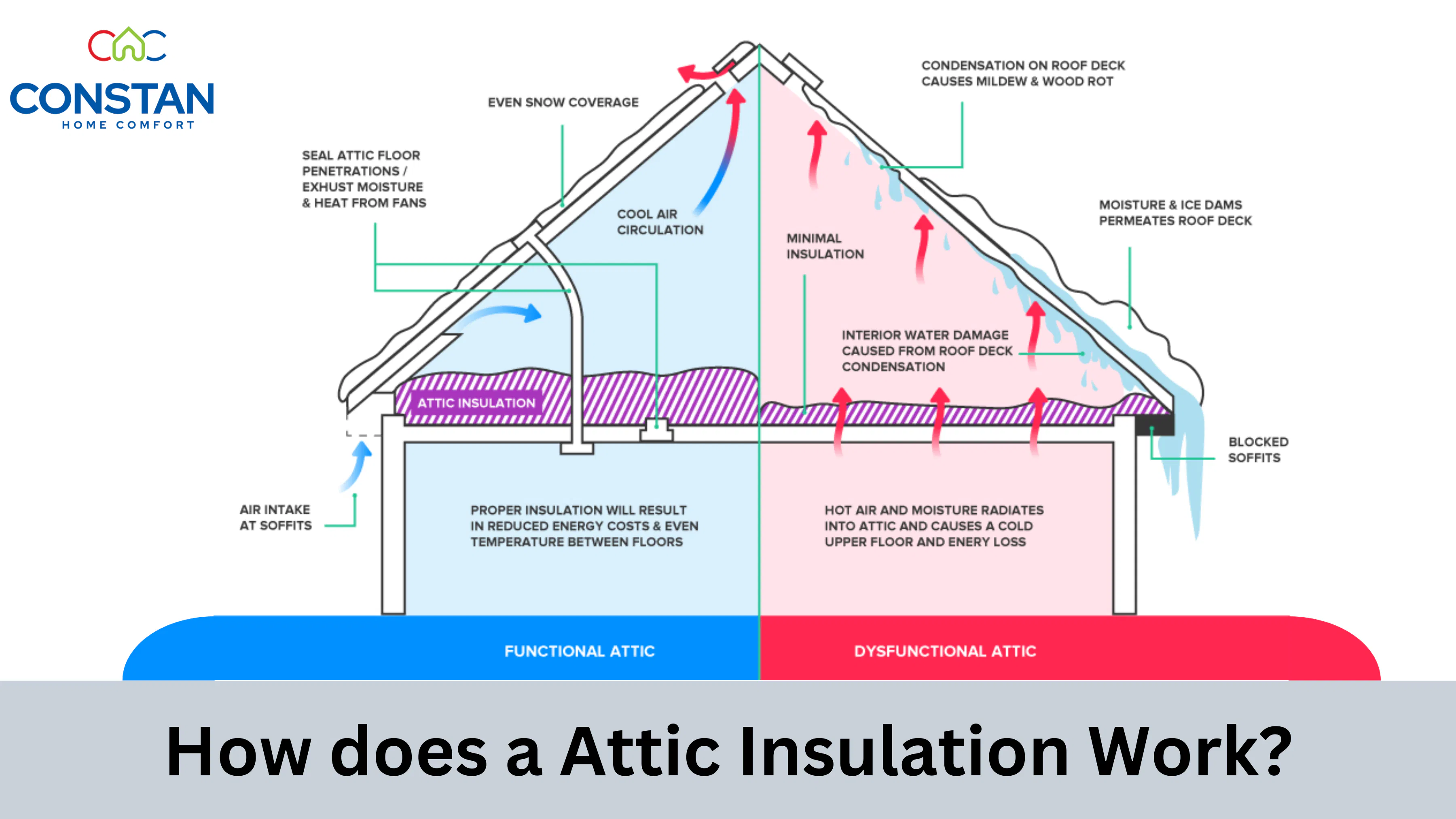
If your home feels drafty in winter, struggles to stay cool in summer, or your energy bills seem unreasonably high, your attic insulation is likely the culprit. Attic insulation is one of the most impactful upgrades you can make to improve year-round comfort and lower your heating and cooling costs — and in Ontario, it may even qualify for government rebates of up to $5,000.
At Constant Home Comfort, we install professional attic insulation throughout Toronto, the GTA, and across Ontario. This guide breaks down exactly how attic insulation works, what types are available, and why upgrading yours is one of the smartest investments you can make for your home.
Your attic sits directly beneath your roof — and without proper insulation, it acts like a massive thermal sponge. In winter, heat generated by your furnace or heat pump rises naturally and escapes straight through an under-insulated attic, forcing your heating system to work overtime. In summer, radiant heat from the sun bakes through your roof and pours into your living spaces, spiking your air conditioning demand.
Attic insulation creates a thermal barrier between your conditioned living space and the harsh outdoor environment. It slows the transfer of heat — keeping warmth inside during cold Ontario winters and blocking heat from entering during hot summers. The result is a more stable indoor temperature, reduced strain on your HVAC equipment, and significantly lower energy bills throughout the year.
Insulation works by trapping tiny pockets of air within its material. These air pockets resist the flow of heat, slowing conduction (heat moving through solid materials), convection (heat carried by air movement), and radiation (heat traveling as infrared energy). The thicker and denser the insulation, the more effectively it resists heat transfer.
The Science of R-Value
The effectiveness of insulation is measured by its R-value — R standing for thermal resistance. The higher the R-value, the better the insulation performs at slowing heat transfer. In Ontario, Natural Resources Canada recommends attic insulation with an R-value between R-50 and R-60 for most homes, depending on the region and climate zone.
Many older Ontario homes have attic insulation with R-values as low as R-12 or R-20, which is woefully inadequate for our climate. Upgrading to the recommended R-value can reduce heat loss by up to 40% and deliver noticeable savings on your monthly energy bills from day one.
The Three Paths Heat Takes Through Your Attic
Understanding how heat moves helps explain why insulation works so well:
- Conduction — Heat moves through solid materials like wood, drywall, and roofing. Dense insulation materials like rigid foam boards are excellent at blocking conductive heat flow.
- Convection — Warm air rises and circulates, carrying heat upward through gaps and into your attic. Blown-in and spray foam insulation both seal these air pathways effectively.
- Radiation — The sun radiates heat energy into your roof, which then radiates downward into your home. Insulation with a high R-value slows this radiant transfer, keeping your upper floors cooler in summer.
Not all insulation is the same. The right product for your home depends on your current insulation levels, attic structure, budget, and goals. At Constant Home Comfort, we assess your home and recommend the best solution for maximum performance and rebate eligibility.
1. Blown-In Insulation (Loose-Fill)
Blown-in insulation — typically made from cellulose or fibreglass — is the most popular choice for attic upgrades in Ontario. Using specialized equipment, technicians blow loose material evenly across your attic floor, filling every gap and crevice for consistent coverage. It is fast to install, cost-effective, and works exceptionally well at topping up existing insulation that has settled or degraded over time.
Blown-in cellulose is made from recycled materials and carries excellent environmental credentials, while fibreglass blown-in offers superior moisture resistance. Both achieve the high R-values required for Ontario's climate zones when applied at sufficient depth.
2. Spray Foam Insulation
Spray polyurethane foam (SPF) is applied as a liquid that expands and hardens into a rigid, airtight seal. It is the gold standard for attic air sealing — critical in older Ontario homes where decades of settling have created gaps, cracks, and bypasses where conditioned air escapes.
Open-cell spray foam is softer and more flexible, ideal for filling larger cavities, while closed-cell spray foam is denser and provides the highest R-value per inch of any insulation product (approximately R-6 to R-7 per inch). Spray foam is particularly effective around attic hatches, plumbing stacks, electrical penetrations, and other areas where air sealing matters most.
3. Batt Insulation (Fibreglass or Mineral Wool)
Fibreglass or mineral wool batts are pre-cut rolls designed to fit between attic joists. They are commonly used in new construction or as a supplemental layer in attics with existing batt insulation. Batts are straightforward to install but require precise fitting to perform well — gaps or compression significantly reduce their effectiveness.
4. Rigid Foam Board
Rigid foam boards are dense panels that deliver a high R-value in a thin profile. They are often used in finished attics or as a supplemental layer on attic hatches and doors — areas commonly overlooked but responsible for significant heat loss. At Constant Home Comfort, our technicians inspect and insulate these critical areas as part of every attic upgrade.
Many Ontario homeowners are unaware that their attic insulation has degraded, settled, or was never installed to an adequate depth in the first place. Here are the most common signs it is time to assess and upgrade your attic insulation:
- Your heating and cooling bills have been climbing year over year with no clear explanation
- Certain rooms feel much colder or warmer than the rest of your home, especially upper-floor rooms
- You can feel cold air drafts or notice frost forming near the attic hatch in winter
- Your HVAC system runs more frequently or for longer cycles than it used to
- Ice dams have formed along your roofline after snowfall — a classic sign of heat escaping through an under-insulated attic
- Your home was built before 1990 and has never had an insulation upgrade
- You notice moisture, mould, or musty odours in your attic
Upgrading your attic insulation is one of the highest-return home improvement investments available to Ontario homeowners. The benefits extend well beyond simple energy savings:
Lower Energy Bills Year-Round
Proper attic insulation reduces heat loss in winter and heat gain in summer. Most Ontario homeowners see a meaningful reduction in their heating and cooling costs within the first full year after upgrading — often in the range of 15% to 30%, depending on previous insulation levels and home size.
Extended HVAC Equipment Life
When your attic is properly insulated, your furnace, air conditioner, and heat pump no longer need to run as hard or as often to maintain your desired temperature. Reduced run times translate directly into less wear and tear on your equipment, fewer repair calls, and a longer equipment lifespan.
Improved Indoor Comfort
Drafty rooms, cold floors above an unheated garage, and temperature swings between floors are almost always insulation problems. Properly insulated attics create a more even, consistent temperature throughout your home — no more retreating to the middle floor in winter or cranking the AC in summer.
Better Indoor Air Quality
Gaps and bypasses in your attic allow outdoor air, dust, pollen, and even pests to enter your living spaces. A well-sealed, properly insulated attic creates a stronger building envelope that keeps contaminants out and your indoor air cleaner.
Increased Home Value
Energy-efficient homes are increasingly sought after in Ontario's real estate market. Documented attic insulation upgrades, especially those combined with HVAC improvements, can increase your home's assessed value and make it more attractive to buyers.
One of the most compelling reasons to upgrade your attic insulation now is the availability of government rebates through Ontario's Home Renovation Savings Program, delivered through Enbridge Gas and Save on Energy. Eligible homeowners may qualify for rebates of up to $5,000 toward attic insulation upgrades — dramatically reducing your out-of-pocket cost.
To qualify, insulation must be installed by a registered contractor (like Constant Home Comfort) and meet minimum R-value requirements. Rebates are limited and issued on a first-come, first-served basis, so acting sooner rather than later ensures you do not miss out.
Constant Home Comfort is a registered, fully licensed insulation contractor across Ontario. Our team manages the entire rebate application process on your behalf — so you get the upgrade and the savings without the paperwork headache.
We make upgrading your attic insulation simple, transparent, and stress-free. Here is what to expect when you work with us:
- Free In-Home Assessment — A certified technician visits your home, inspects your current attic insulation levels and air sealing, and identifies any bypasses, moisture issues, or structural concerns.
- Custom Recommendation — We provide a clear, written recommendation for the type and depth of insulation best suited to your home, along with a transparent quote and information about applicable rebates.
- Professional Installation — Our trained crew installs your insulation efficiently and cleanly, protecting your belongings and finishing the job typically within a single day.
- Rebate Assistance — We submit the required documentation on your behalf and help you claim every dollar of rebate you are entitled to.
- Post-Installation Follow-Up — We follow up to ensure you are satisfied with the results and answer any questions about your newly upgraded home.
How much insulation does my attic need?
Most Ontario homes should have attic insulation with a total R-value of R-50 to R-60. If your attic currently has less than 12 inches of insulation, it is almost certainly performing below this threshold and would benefit from an upgrade.
How long does attic insulation installation take?
A typical attic insulation upgrade takes between four and eight hours for an average-sized Ontario home. Larger homes or those requiring significant air sealing work may take a full day.
Does new insulation fix ice dams?
Upgrading attic insulation, combined with proper air sealing and attic ventilation, is the most effective long-term solution for preventing ice dams. Ice dams form when heat escapes from the living space through the attic, melts roof snow, and refreezes at the eaves — a problem that disappears when the attic is properly insulated.
Can I install attic insulation myself?
While basic batt installation is within reach of handy homeowners, blown-in and spray foam insulation require specialized equipment and training to install correctly. More importantly, DIY installation does not qualify for Ontario government rebates, which require work to be completed by a registered contractor. Professional installation ensures correct coverage, proper air sealing, and rebate eligibility.
How do I know if my current insulation is still effective?
Insulation can degrade, compress, or become moisture-damaged over time. The best way to assess your current insulation is with a professional inspection. Our team provides free attic assessments for Ontario homeowners — we measure existing depths, check for air bypasses, and give you an honest evaluation of what your attic needs.
Do not let your attic drain your energy budget and compromise your comfort for another season. Constant Home Comfort provides professional attic insulation upgrades across Toronto, the GTA, Ottawa, Hamilton, Barrie, and throughout Ontario — backed by government rebate expertise and a commitment to quality that has made us one of Ontario's most trusted home comfort providers.
Call us today at 1 (888) 675-5907 or book your free in-home assessment online. Our team will assess your attic, explain your options, and help you claim every available rebate — at no obligation to you.
One call. One company. Complete home comfort.