 Work Time
HRV vs. ERV Systems: Which Ventilation Unit Suits Ontario’s Climate?
The Tight Home Paradox in Ontario's Communities
If you walk into a newly built home anywhere in Ontario today, you'll immediately notice how quiet and solid it feels. From Markham, Richmond Hill, and Vaughan to expanding residential pockets in Durham, Mississauga, and Newmarket, modern homes are designed to lock in heating and cooling. Today's builders use tightly sealed thermal envelopes, continuous vapor barriers, and high-performance windows to stop drafts and lower utility bills. While this airtight design is fantastic for your wallet, it creates a hidden problem: it traps stale, polluted, and humid air inside your living space.
Without controlled fresh air coming in, a sealed house acts like a plastic bag, collecting a mix of indoor air pollutants. Every day, your home gathers carbon dioxide from breathing, volatile organic compounds (VOCs) off-gassing from synthetic carpets or new furniture, and common allergens like dust mites and pet dander. When these pollutants build up, they ruin your indoor air quality and can trigger asthma and other respiratory issues for your family.
Moisture is another constant battle. Simple daily routines like cooking, hot showers, doing laundry, and even breathing release moisture into the air. In a sealed home, this moisture has nowhere to go. During freezing Ontario winters, that damp indoor air hits cold exterior surfaces like window panes, turning into condensation. Over time, this standing water can ruin window frames, rot drywall, and encourage toxic mold growth.
Standard exhaust fans in your bathroom or kitchen range hood don't solve this whole-home issue. They simply push air out without replacing it. This depressurizes your house, pulling unconditioned, unfiltered outdoor air through random tiny cracks in your walls, creating cold drafts and wasting energy.
This is why balanced mechanical ventilation is now a necessity. Think of Heat Recovery Ventilators (HRVs) and Energy Recovery Ventilators (ERVs) as the mechanical lungs of your home. They continuously pull out stale, polluted indoor air and bring in an equal amount of fresh, filtered outdoor air, exchanging energy along the way so your heating and cooling systems don't have to work double-time.
Core Engineering: How HRVs and ERVs Manage Thermodynamics
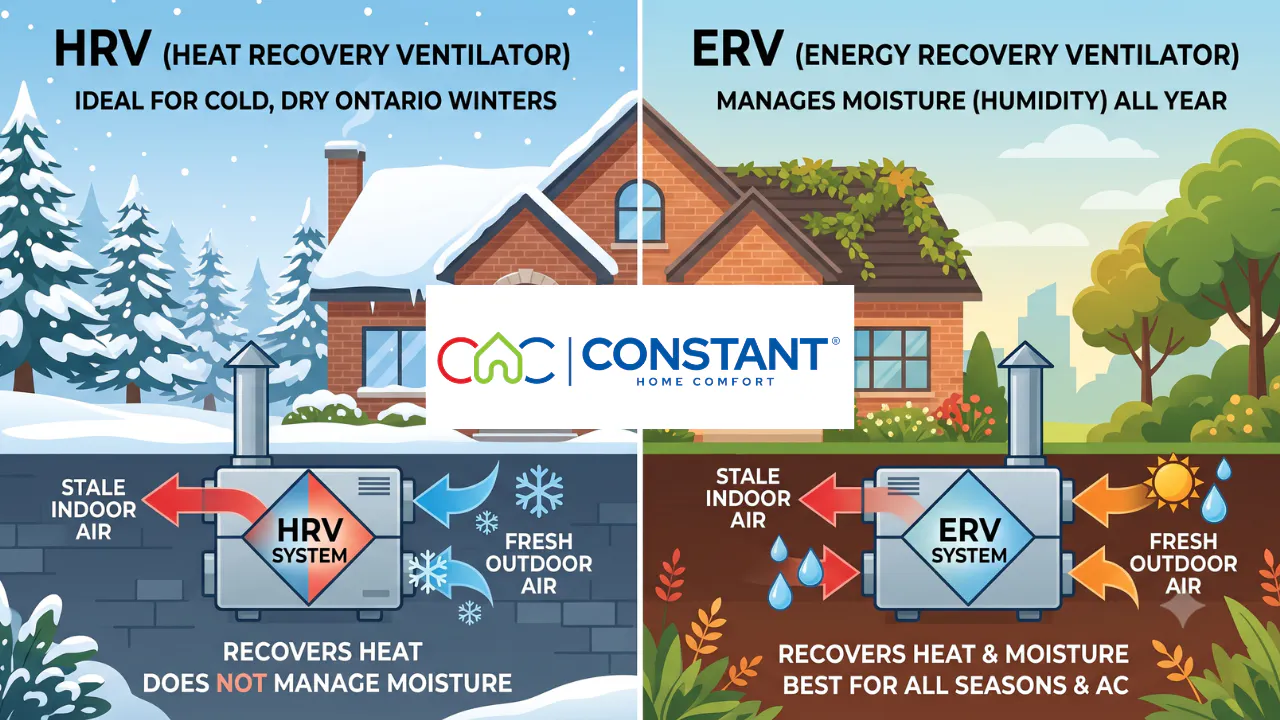
While HRVs and ERVs look very similar on the outside, they handle temperature and moisture in completely different ways.
Heat Recovery Ventilators (HRVs)
- Heat-Only Exchange: An HRV uses a core designed to transfer temperature only, not moisture.
- Winter Action: In the winter, the warm, damp indoor air conducts its heat across the core plates to warm up the incoming cold, dry outdoor air. The streams never mix, meaning the fresh air remains clean.
- Moisture Removal: Because it doesn't transfer moisture, the damp indoor air is completely exhausted outside, and dry outdoor air is brought in. This makes the HRV an incredible tool for drying out damp homes and stopping window condensation.
Energy Recovery Ventilators (ERVs)
- Heat and Moisture Exchange: An ERV uses a specialized enthalpy core that allows both heat and water vapor to migrate between the two air streams.
- Winter Action: It captures moisture from your warm outgoing indoor air and transfers it back to the dry incoming winter air, keeping your home's humidity at a comfortable level.
- Summer Action: In the humid summer months, the process reverses. The ERV pre-dries the incoming muggy outdoor air by transferring its moisture to the drier outgoing exhaust air, which takes a massive load off your air conditioner.
Regional Climatic Mapping: Matching Ventilation to Local Weather
Ontario's weather is notoriously dramatic, with freezing winters and muggy summers. Choosing between an HRV and an ERV depends heavily on where you live in the province.
The Extreme Cold Zone: Ottawa, Kanata, and Barrie
- In places like Ottawa, Kanata, and Barrie, winter temperatures regularly plummet below -25 degrees Celsius. Outdoor air at these temperatures holds almost zero moisture, making indoor air feel dry and static-heavy once heated.
- However, because homes in these cold regions are built tightly, daily indoor activities still trap plenty of moisture that condenses on cold window glass.
- For most homes in these areas, an HRV is the ideal choice because it actively flushes out that excess winter moisture.
- To prevent your indoor air from becoming too dry, the most reliable setup is pairing an HRV with a central, whole-home humidifier (like an Aprilaire system) installed directly onto your furnace. The HRV keeps your air fresh and your windows dry, while the humidifier maintains healthy indoor humidity between 35 and 50 percent.
The Humid Lakeside Zone: Hamilton, Burlington, Mississauga, Toronto, and the GTA
- Homes built near Lake Ontario experience milder winters but incredibly humid summers, with outdoor dew points often climbing very high in July and August.
- Running an HRV in these humid months can pull heavy outdoor humidity straight into your home, forcing your air conditioner to work much harder.
- In this zone, an ERV is often the superior choice. By blocking outdoor humidity from entering your home during the summer, the ERV keeps your indoor space drier and reduces your air conditioning load by 20 to 30 percent, helping to prevent damp basement issues.
The Southwestern Corridor: Waterloo and London
- Communities in Waterloo and London experience cold, dry winters alongside warm, humid summers.
- For older, slightly draftier homes, an HRV is excellent at keeping winter moisture under control.
- For newer, highly airtight homes, an ERV is becoming the preferred option. It recycles indoor moisture in the winter to prevent dry skin and static, while keeping summer humidity outdoors.
Technical Comparison: Lennox Healthy Climate Systems
At Constant Home Comfort, we supply and install top-tier ventilation systems engineered for Ontario's demanding seasons. Here is a look at how the Lennox Healthy Climate HRV and ERV models compare:
Lennox Healthy Climate Heat Recovery Ventilators (HRV)
- Available Models: Includes the high-performance HRV5-200, HRV6-150, and HRV3-195 units.
- Maximum Coverage Area: Built to ventilate larger residential properties up to 4,200 square feet.
- Heat Recovery Efficiency: Recovers up to an impressive 90 percent of heat from outgoing indoor air.
- Airflow Capacity: Models range in size to deliver anywhere from 95 to 278 CFM based on your home's layout.
- Defrost Protection: Features an electronically controlled damper to prevent freeze-ups in cold weather.
Lennox Healthy Climate Energy Recovery Ventilators (ERV)
- Available Models: Includes the advanced ERV5-150-TPD, ERV5-130, and ERV3-150 units.
- Maximum Coverage Area: Optimized for mid-to-large-sized homes up to 3,800 square feet.
- Total Energy Recovery: Reclaims up to 75 percent of total energy, successfully managing both temperature and moisture.
- Airflow Capacity: Models range from 130 to 200 CFM.
- Defrost Protection: Operates with an automatic, electronic defrost cycle to maintain peak performance.
Shared Features
- Air Filtration: Both systems use a washable MERV-4 high-airflow filter to keep dust, pollen, and larger outdoor particles out of your home.
- System Compatibility: Both units integrate seamlessly with all types of residential HVAC systems.
- Warranty Support: Backed by a dependable 5-Year Limited Warranty on all covered components.
Building Envelope Synergy and Whole-Home Energy Upgrades
A ventilation system shouldn't work in isolation; it works best when paired with the rest of your home comfort upgrades. Constant Home Comfort offers professional attic and crawl space insulation services that work hand-in-hand with your HVAC equipment. By sealing thermal leaks in your attic, we prevent heat loss in winter and keep heat out in the summer.
Once your home is well-insulated and sealed, accidental drafts are minimized, making a balanced HRV or ERV system essential to ensure you always have fresh air. This works beautifully with other modern systems:
- Cold-Climate Heat Pumps: We install advanced ductless and central heat pumps that operate efficiently down to -30°C. Pairing a heat pump with an HRV or ERV ensures your fresh outdoor air is pre-heated or pre-cooled before entering your living space, preventing chilly drafts and lowering your heating bills.
- Tankless Water Heaters: Upgrading to a compact tankless water heater, such as a Rinnai or Navien model, gives you endless hot water on demand while cutting down on space and monthly gas costs.
- Ductwork Sealing and Care: Properly sealed ductwork is vital. If your ducts are leaky or dirty, the fresh air from your ventilator won't distribute evenly, leaving some rooms stuffy and others drafty. Professional sealing ensures fresh, filtered air reaches every corner of your home.
Legality and Compliance: Navigating the 2024 Ontario Building Code
Under the 2024 Ontario Building Code, which came into full force on April 1, 2025, mechanical ventilation with heat or energy recovery is now a mandatory requirement for all new residential builds. Old house classifications are gone, and omitting heat recovery is no longer an option.
Before you can obtain a building permit in Ontario, you must submit a certified Mechanical Ventilation Design Summary (MVDS). This document must verify:
- The exact manufacturer and model of the HRV or ERV you are installing.
- The certified Sensible Recovery Efficiency (SRE) of the system at -25°C.
- The Total Ventilation Capacity (TVC) calculated under the CAN/CSA-F326 standard.
This code-mandated calculation ensures fresh air is distributed properly. For instance, your basement and primary bedroom must receive a fresh air supply of at least 10 L/s (21 CFM), while secondary bedrooms and other living spaces require a minimum of 5 L/s (11 CFM). Additionally, the building code requires a minimum SRE of 55 percent at -25°C, which rises to 65 percent or higher for high-performance builds, such as Passive House or Insulating Concrete Form (ICF) homes.
Financial Incentives, Financing, and Easy Next Steps
Note: Rebate amounts and eligibility can change over time. For the latest incentives, visit our Promotion page.
Upgrading your home’s ventilation and heating is a smart investment that pays off in long-term comfort, energy savings, and health. Constant Home Comfort helps Ontario homeowners access several major rebate and financing programs to make these upgrades highly affordable :
- Home Renovation Savings Program: As an approved contractor, Constant Home Comfort can help you qualify for up to $7,500 for a cold-climate heat pump, with total combined rebate savings potentially reaching up to $14,000 when layering in federal energy retrofits. Our team handles all the eligibility checks, prepares the applications, and submits the paperwork on your behalf at no extra charge.
- CMHC Eco Improvement Program: If you have a CMHC-insured mortgage and spend $20,000 or more on qualifying energy-efficient upgrades—like combining a heat pump, attic insulation, and an HRV or ERV—you can receive a 25 percent partial refund on your mortgage insurance premium. You have two years from your closing date to complete the work and apply.
- Affordable Financing Options: We make home comfort upgrades easy with low monthly payment plans starting from $49.99, rent-to-own programs with zero upfront costs, and $0 down, interest-free financing options on credit approval.
Reliable, Local HVAC Solutions Across Ontario
Constant Home Comfort is one of Ontario's largest and most trusted home comfort companies. We proudly serve communities across the province, including Markham, Richmond Hill, Scarborough, Durham, Mississauga, Vaughan, Newmarket, Ottawa, Waterloo, London, Barrie, Hamilton, Burlington, and Kanata.
With fully licensed local technicians, 24/7 emergency repair services, same-day installations, and a commitment to using only high-quality, fully warranted materials, we stand behind our workmanship and aim to get the job done right on the very first visit.
Whether you want to resolve winter window condensation, lower your heating bills, or ensure your home meets the latest Ontario building codes, professional advice is just a quick call away.
To schedule your free, no-obligation estimate and find the perfect ventilation system for your home, contact Constant Home Comfort today at 1-888-675-5907.