 Work Time
R-410A Sunset: Navigating the New A2L Refrigerants
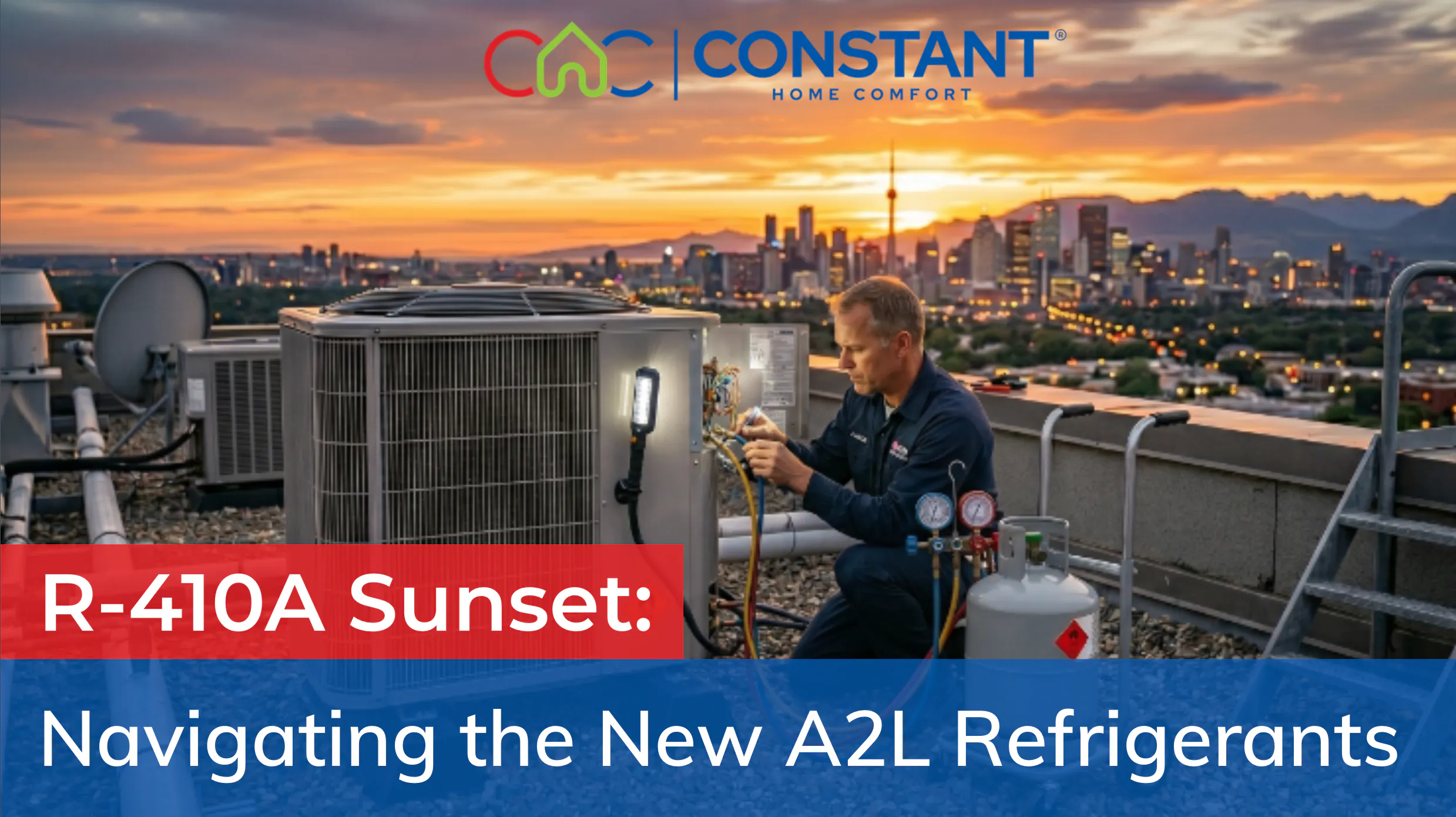
The mechanical framework governing residential indoor climate control throughout Canada is undergoing its most significant structural realignment in decades. If you are a homeowner, navigating these changing environmental rules can feel overwhelming. This guide breaks down exactly what is happening, why it matters to your wallet, and how to future-proof your home comfort.
1. The Macro Regulatory Shift in Canadian HVAC Architecture
Effective January 1, 2026, federal environmental mandates officially prohibited the production and import of new heating, ventilation, and air conditioning (HVAC) equipment powered by the legacy R-410A refrigerant.
This shift represents the operational execution of Canada's commitments under the Kigali Amendment to the Montreal Protocol. This binding global accord requires participating nations to systematically reduce aggregate hydrofluorocarbon (HFC) consumption by 85% by the year 2036.
Why is R-410A Being Retired?
While R-410A was originally introduced in the late 1990s as an ozone-safe alternative to R-22, subsequent atmospheric research revealed a severe trade-off in the form of massive thermal retention.
- High Global Warming Potential: R-410A carries an established Global Warming Potential (GWP) rating of 2,088. This means releasing a single kilogram of this gas exerts the same heat-trapping effect as 2,088 kilograms of carbon dioxide.
- Targeting Building Emissions: Heating and cooling operations in residential and commercial structures generate nearly 20% of total Canadian carbon emissions.
- The New Regulatory Limit: Regulatory bodies have implemented a strict maximum GWP ceiling of 700 to 750 for all new comfort cooling installations.
This environmental threshold renders the continued manufacturing of standard R-410A systems obsolete and requires a complete transition to alternative chemical compounds.
What This Means for Ontario Homeowners
For regional service providers managing residential infrastructure across Ontario, this transition radically alters long-term equipment planning and capital allocation. Local specialists like Constant Home Comfort operate as long-term partners to help residential property owners navigate these shifting compliance frameworks without experiencing service disruptions.
This regulatory shift directly impacts diverse climate zones across the province, including:
- High-Density GTA Hubs: Markham, Richmond Hill, Scarborough, Mississauga, and Vaughan.
- Rapidly Expanding Municipal Corridors: The Durham region and Newmarket.
- Eastern Ontario Links: Ottawa and Kanata.
- Southwestern and Central Communities: Waterloo, London, Barrie, Hamilton, and Burlington.
Property owners must understand that the sunset of R-410A does not mean their existing, functional air conditioners are suddenly illegal to operate. Instead, it dictates that any new equipment installation executed after the deadline must embrace the updated refrigerant standard.
As older systems age out over the next decade, the pricing of legacy chemical refrigerants like R-410A will inevitably rise due to tightening federal import and manufacturing quotas. This makes early technical education an asset for homeowners. By understanding these mechanical realities today, you can make proactive, cost-effective investments rather than rushed emergency purchases during a mid-summer heatwave.
2. Thermodynamic and Environmental Profiles of Contemporary Refrigerants
To achieve compliance with the maximum 750 GWP ceiling, the global HVAC manufacturing sector settled on a specific class of synthetic fluids classified by ASHRAE as A2L refrigerants. Understanding the safety and performance advantages of these fluids requires a quick look at their standardized classification system.
Decoding the "A2L" Safety Label
- Letter A (Low Toxicity): Designates that the chemical compound exhibits lower toxicity levels, preserving the exact safety benchmarks established by legacy non-flammable A1 gases like R-410A.
- Number 2 (Flammability): Indicates that the compound possesses a flammability profile, meaning it can ignite under very specific conditions.
- Letter L (Low Burning Velocity): Signifies an incredibly low burning velocity, precisely quantified as less than 10 centimeters per second.
The Reality of Mild Flammability
The introduction of mild flammability parameters into residential ducted systems has caused some consumer hesitation, yet the chemical dynamics of A2L compounds indicate a highly stable profile.
Unlike highly flammable A3 hydrocarbon options like propane or isobutane, A2L fluids require exceptionally high concentrations and high-energy thermal triggers to initiate even a localized flame.
- High Lower Flammability Limit (LFL): The LFL represents the minimum concentration of the gas within an ambient space required to sustain combustion. The allowable safety concentration threshold for standard A2L applications is nearly ten times higher than that of propane, meaning an immense volume of gas must leak simultaneously into a confined zone to even reach a combustible state.
- Immunity to Everyday Ignition Triggers: A2L mixtures cannot be ignited by static electricity from human touch, nor can they be detonated by standard household electrical currents, wall light switches, household toasters, or hair dryers.
- Extreme Thermal Thresholds: True ignition requires an auto-ignition temperature of 928 degrees Fahrenheit (498 degrees Celsius) paired with a continuous, sustained open flame source.
- Self-Extinguishing Behavior: Because of the low burning velocity, even if a localized ignition occurs, the flame front moves so slowly that it typically self-extinguishes rather than propagating violently outward.
3. Mechanical Structural Distinctions: R-32 versus R-454B
The modern comfort cooling landscape has bifurcated around two primary low-GWP alternatives designed to replace legacy components. Discerning between these platforms requires evaluating their chemical composition, thermodynamic behavior, and long-term regulatory resilience.
Profile 1: R-32 (Pure Single-Component Refrigerant)
R-32 operates as an unblended chemical compound, which yields a distinct mechanical advantage in the field: zero temperature glide.
- Uniform Evaporation: Because R-32 is pure, it evaporates and condenses at a completely uniform temperature profile.
- Simplified Servicing: If a system experiences a localized leak, the remaining refrigerant retains its exact chemical ratio. This allows field technicians to easily execute partial recharges without evacuating the entire system charge.
- Common Applications: Major manufacturing brands like Daikin, Mitsubishi, and LG utilize R-32 extensively within ductless mini-split applications and decentralized residential arrays across Ontario.
- Future Regulatory Risk: Because its GWP rating of 675 sits closer to the maximum 750 regulatory limit, some equipment designers note that R-32 may face secondary restrictions in future decades if federal mandates tighten further.
Profile 2: R-454B (The Next-Generation Blend)
R-454B—marketed under trade designations such as Puron Advance or Opteon XL41—is a zeotropic blend composed of 69.1% R-32 and 30.9% R-1234yf.
- Maximum Environmental Resilience: R-454B achieves an exceptionally low GWP rating of 466, delivering a 78% total emissions reduction relative to the legacy systems it replaces. This positions it securely against future regulatory updates.
- Legacy Pressure Matching: R-454B operates at physical pressures and temperatures that nearly mirror legacy R-410A systems.
- Flattened Learning Curve: This engineering commonality significantly flattens the learning curve for field service technicians and allows equipment developers to transition their core product lines without executing radical structural redesigns.
- Minimal Temperature Glide: While it is technically a blend, it displays an exceptionally low temperature glide. It can still be reliably topped off following localized leak repairs without requiring a full evacuation and reclamation of the remaining charge.
- Common Applications: Major ducted equipment manufacturers, including Carrier, Trane, York, and Lennox, have chosen R-454B as their primary fluid for whole-home central split systems and ducted heat pumps.
The Crucial Rule: Zero Backwards Compatibility
A critical operational boundary regarding these next-generation technologies is the complete and total absence of backwards compatibility.
- No Drop-In Solutions: There are no drop-in chemical replacements engineered for older residential units.
- Strict Safety Violations: A mechanical system originally constructed for a non-flammable A1 refrigerant like R-410A cannot be retrofitted or charged with an A2L fluid like R-454B or R-32 under any circumstances. Attempting to do so violates provincial safety codes and introduces severe mechanical risks.
- Incompatible Internal Components: Legacy compressors, electrical contactors, and expansion valves lack the intrinsic electrical shielding, safety controls, and pressure ratings required to safely manage mildly flammable compounds.
- Full System Replacements: When an older air conditioner or heat pump fails entirely, the entire outdoor condenser, indoor coil, and connecting lineset must be replaced to match the new safety architecture.
4. Provincial Compliance, TSSA Standards, and Mechanical Safeguards
Integrating mildly flammable gases into the provincial housing infrastructure required a comprehensive overhaul of Ontario's legal and safety framework. These regulations ensure public safety while keeping installation timelines moving efficiently.
Technical Standards and Safety Authority (TSSA) Updates
The foundational authority governing pressure-retaining mechanical assemblies, the TSSA, enacted a pivotal regulatory update by amending the Code Adoption Document effective October 1, 2024.
- Adoption of CSA B52:2023: This amendment officially adopted the CSA B52:2023 Mechanical Refrigeration Code, establishing the formal provincial legal mechanism permitting the installation and operation of A2L systems across Ontario structures.
- Ontario Building Code Harmonization: Simultaneously, the Ministry of Municipal Affairs and Housing updated the Ontario Building Code, with references taking full effect on January 1, 2025, to harmonize municipal building construction with the updated ventilation and structural layouts outlined in the CSA B52 code.
- The 500 kW Design Registration Exemption: To lower bureaucratic friction for small businesses and homeowners, the updated framework introduces an important administrative exemption. Comfort cooling systems utilizing certified A1 or A2L refrigerants with a total prime mover capacity up to 500 kilowatts no longer require formal provincial design registration. This applies as long as the equipment has received formal certification from an agency accredited by the Standards Council of Canada, dramatically accelerating project approval timelines for standard residential retrofits.
Built-In Safety Mitigation Strategies
Because A2L compounds are classified as mildly flammable, modern central air conditioners and heat pumps incorporate advanced factory-engineered mitigation systems to manage potential leak scenarios within the home.
- Continuous Stationary Sensors: Indoor evaporator coils are now fitted with highly sensitive, factory-installed A2L leak detection sensors as a standard operating component. These sensors continuously monitor the air in the cabinet or likely leak-accumulation zones.
- Automated System Shutoff: If a structural fracture occurs within the copper lineset or coil assembly, the sensor identifies the presence of escaping refrigerant vapor before it can exit the mechanical cabinet. The system’s automated controls instantly disengage the high-pressure outdoor compressor to halt the flow of refrigerant.
- Continuous Blower Fan Activation: Simultaneously, the system activates the indoor blower fan to run continuously at maximum capacity. This rapid air circulation dilutes the escaping gas well below the strict Flammable Concentration Limit, neutralizing any risk of a combustible concentration forming inside the living space.
Advanced Technical Tool Infrastructure
For field technicians operating across Ontario, the transition demands a higher tier of professional tool infrastructure and precision training. Field service providers must deploy a specialized toolkit explicitly rated for A2L service to prevent electrical switching arcs from encountering low-velocity gases:
- Spark-Free Vacuum Pumps: Designed to prevent sparking and ignition when pulling a vacuum or handling residual A2L vapors.
- Explosion-Proof Recovery Units: Built with specialized, spark-mitigated electrical components.
- Certified Electronic Leak Detectors: Calibrated specifically to identify low-velocity A2L compounds.
- Dedicated Storage Cylinders: A2L refrigerants are shipped and stored in specialized light-gray cylinders with a red band and unique left-hand threaded valves to prevent accidental mixing with legacy fluids.
Traditional installation practices have been heavily modified. For example, when brazing the copper joints of an A2L-charged system, technicians must confirm the loop is entirely evacuated and run a continuous dry nitrogen purge to stabilize the inner tubing walls, all while placing prominent hazard placards across the active work site.
Furthermore, transportation parameters have shifted; service vehicles moving A2L cylinders across Ontario highways must carry specialized dry-powder Class B fire extinguishers, secure all cylinders firmly to prevent mechanical shifting, and adhere to clear transit labeling guidelines.
5. Strategic Consumer Protections and Rebate Optimization in Ontario
The alignment of the R-410A equipment sunset with expanding provincial energy conservation incentives provides a distinct financial window for Ontario homeowners. Residential consumers transitioning their cooling infrastructure must evaluate several short-term capital premiums against long-term operational liabilities.
The Cost Realities of Upgrading
Current market metrics indicate that new equipment utilizing A2L standards carries an upfront manufacturing premium of roughly $300 to $800. This translates to an approximate 15% to 30% overall system cost escalation over older R-410A units due to built-in safety electronics, advanced factory testing, and specialized regulatory compliance measures.
When advising property owners across Ontario—whether located in eastern hubs like Ottawa and Kanata, southwestern sectors like Waterloo and London, or central zones encompassing Barrie, Hamilton, and Burlington—licensed contractors look first to equipment age and structural integrity to determine the best financial path:
- If Your System is Under 10 Years Old: Keep using it. There is no economic or legal reason to execute a premature replacement, as parts and refrigerant supplies remain fully available for regular maintenance and emergency repairs.
- If Your System is 12 to 15+ Years Old: If an older unit encounters a major component breakdown (like a failed compressor or a ruptured evaporator coil), investing in an expensive R-410A repair becomes high-risk. The ongoing contraction of federal HFC import quotas will inevitably drive up the wholesale cost of legacy refrigerants, making future recharges financially punitive. In these scenarios, replacing the system with a modern A2L configuration represents the most secure path forward.
Maximizing the 2026 Home Renovation Savings Program
To offset the initial capital premium of these compliant systems, property owners can leverage the 2026 Home Renovation Savings Program, a joint initiative delivered through Save on Energy and Enbridge Gas. This program rewards homeowners who upgrade to high-efficiency, cold-climate air-source heat pumps, with incentive structures scaling according to the building's current primary fuel source:
- Natural Gas Properties: Homeowners possessing an active Enbridge Gas residential heating account can claim a direct rebate of $500 per ton of installed capacity, up to a maximum program cap of $2,000.
- Non-Gas Properties: Residences reliant on electricity, heating oil, propane, or wood receive an elevated incentive rate of $1,250 per ton of capacity, maxing out at a cap of $7,500.
- Geothermal Systems: Ground-source installations qualify for the highest funding tier, yielding a flat $3,000 for gas-heated properties and up to $2,000 per ton up to a maximum of $12,000 for non-gas structures.
Key Process Improvements and Program Deadlines
A major procedural improvement introduced for the 2026 season is that a pre-installation home energy audit is no longer required if the heat pump is installed as a single mechanical upgrade. This eliminates upfront administration fees and accelerates installation timelines. However, if you choose the "Bundled Path" to add attic insulation, windows, or air sealing, a full pre- and post-retrofit evaluation is still mandatory but unlocks additional rebates for insulation up to $7,700.
Keep these critical dates and stacking options in mind:
- Registration Deadline: The contractor registration window for this specific rebate stream closes on May 31, 2026. Property owners must confirm their selected provider is fully registered within the provincial system before this deadline to secure their funding.
- Interest-Free Financing: These provincial incentives can be stacked with the federal Canada Greener Homes Loan, which provides interest-free financing up to $40,000 to minimize upfront capital barriers.
- Oil-to-Heat-Pump Affordability (OHPA): For oil-heated homes, stacking the federal OHPA program adds an extra $5,000 to $15,000, frequently covering the entire cost of the mechanical installation.
The Power of Hybrid Dual-Fuel Setups
In regions characterized by extreme winter climates, such as Ottawa or Barrie, implementing a hybrid dual-fuel setup is an exceptionally practical option. A hybrid system pairs a new, high-efficiency A2L heat pump with an existing or new high-efficiency natural gas furnace.
- Summer Performance: The heat pump manages 100% of the home's cooling load during humid summers.
- Shoulder Season Savings: The heat pump provides energy-efficient heating throughout the milder spring and autumn months.
- Winter Backup Protection: When sub-zero winter temperatures arrive and air-source efficiency declines, the system automatically switches to the natural gas furnace backup. This approach qualifies for the Home Renovation Savings Program without requiring the complete removal of functional heating infrastructure.
To ensure full compliance and protect this investment, installations must be performed by a licensed contractor who provides complete price disclosures up front and verifies that the selected equipment appears on the official Natural Resources Canada qualified products list.
Providers like Constant Home Comfort deliver an all-in-one approach across Ontario, handling the entire administrative pre-approval process and ensuring that safety upgrades conform to modern TSSA codes. Furthermore, their teams can pair these mechanical service updates with professional attic and crawl space insulation enhancements to improve the home's thermal envelope and lower utility bills year-round.