 Work Time

Buying a tankless water heater is one of the smartest upgrades you can make to your Ontario home — but only if you buy the right one. The wrong fuel type, undersized unit, or poor installation can cost you thousands in wasted energy and early repairs. This guide walks you through every decision you need to make before you buy, from fuel type and flow rate to venting, features, and available rebates — so you can invest with confidence.
Before choosing a brand or model, the first question to answer is whether tankless is the right move for your specific situation. For the vast majority of Ontario homeowners, the answer is yes — but it helps to understand why.
Tankless is a strong fit if you:
- Are tired of running out of hot water during back-to-back showers or when multiple appliances run at once
- Want to reduce your monthly energy bills — tankless units are 30–40% more efficient than conventional tanks
- Have a natural gas line in your home (gas tankless units are the most cost-effective for Ontario climates)
- Are replacing an aging tank that's approaching the end of its 8–12 year lifespan
- Want to free up space — tankless units are wall-mounted and a fraction of the size of a storage tank
- Are planning to stay in your home for 5+ years — enough time to recoup the investment through energy savings
You may want to reconsider if:
- Your home runs entirely on electricity with no gas line and a panel that cannot be upgraded — electric tankless units require significant amperage
- You live in a very small home or cottage with minimal simultaneous hot water demand — a conventional tank may be sufficient
- You are on a very tight budget and cannot offset the upfront cost through rebates or financing
Still not sure? Our specialists assess your home's hot water usage, fuel source, and existing setup at no charge — call 1-888-675-5907 for a free consultation.
This is the single most important decision in the buying process. The fuel type determines your unit's capacity, efficiency, installation requirements, and long-term running costs.
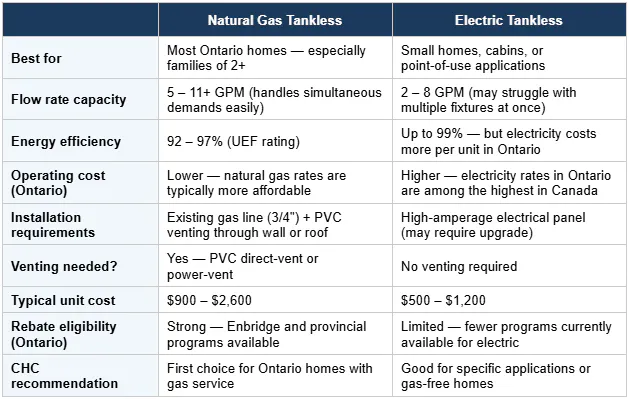
For most Ontario homeowners connected to Enbridge natural gas, a gas tankless water heater is the clear winner on capacity, cost-effectiveness, and rebate eligibility. Electric units make excellent sense as point-of-use heaters or in homes where gas is not available.
Buying an undersized tankless heater is one of the most common and costly mistakes Ontario homeowners make. Here's how to calculate the right size for your household.
Part A — Calculate Your Peak Flow Rate (GPM)
Think about the maximum number of hot water fixtures you might run at the same time — this is your peak demand. Add up the gallons per minute (GPM) for each:
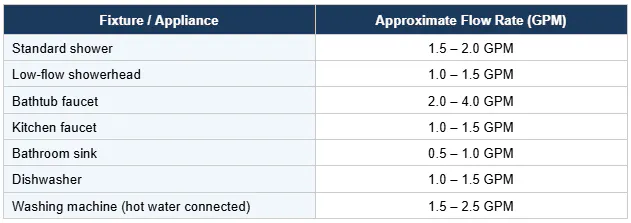
Example: A family running two showers (2.0 GPM each) and a dishwasher (1.5 GPM) simultaneously needs a unit rated for at least 5.5 GPM. We typically recommend sizing up slightly to ensure comfortable performance — a 7–8 GPM unit in this case.
Part B — Factor in Temperature Rise
A tankless heater must raise the incoming cold water temperature to your desired output temperature. In Ontario, groundwater temperatures typically sit between 4°C and 10°C (39°F – 50°F) in winter. If you want water delivered at 49°C (120°F), your unit needs to achieve a temperature rise of 39°C to 45°C (70°F – 81°F).
The higher the required temperature rise, the lower the achievable flow rate for a given unit. This is why units that perform well in warmer US climates can underperform in Ontario winters — and why it's important to choose a model rated for Canadian cold-water conditions. Rinnai and Navien both publish Canadian-specific performance data.
General Sizing Guide by Household Size
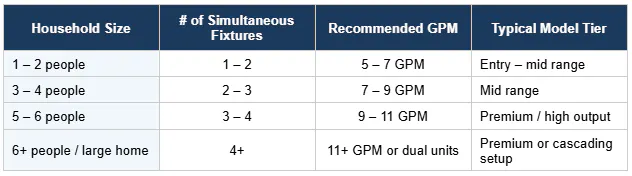
Our HVAC specialists calculate your exact requirements during a free in-home assessment — taking into account your home's layout, existing plumbing, and real-world usage patterns. Call 1-888-675-5907 to book yours.
Gas tankless water heaters must vent combustion gases safely out of your home. The venting method you choose affects installation cost, flexibility of placement, and the unit's overall efficiency. There are three main types:
1. Direct Vent (Most Common in Ontario)
Uses a sealed, two-pipe PVC system: one pipe draws combustion air in from outside, another exhausts gases out. The unit is sealed from your living space, making it the safest and most energy-efficient option. It can be vented horizontally through an exterior wall, making installation straightforward in most Ontario homes. This is what we install in the vast majority of our jobs.
2. Power Vent
Draws combustion air from the room and vents exhaust outside using a motorized blower through PVC piping. Can vent horizontally over longer distances than direct-vent, offering more placement flexibility. A good choice when the unit needs to be installed further from an exterior wall.
3. Atmospheric Vent (Older Style — Rarely Recommended)
Uses a traditional metal flue and relies on natural convection to exhaust gases upward. Less efficient than direct or power vent, and not available on most modern high-efficiency units. If you have an old atmospheric-vent tank being replaced, your new tankless unit will almost certainly require a new venting configuration.
Our technicians will assess your home's layout and recommend the most practical venting solution. The cost of venting is included in our installation quotes.
Not all tankless water heaters are built the same. Here are the features that actually matter for Ontario homeowners — and what to look for when comparing models:
- Energy Factor / UEF Rating: The Uniform Energy Factor (UEF) is the standardized efficiency rating for water heaters. Look for a UEF of 0.92 or higher for gas units. Top-rated models from Navien and Rinnai reach 0.96–0.97. A higher UEF means lower operating costs over the unit's lifetime.
- Built-in Recirculation Pump: Recirculation pumps keep hot water moving through your pipes so it arrives at your tap almost instantly — no waiting and no wasted water running cold. This is a must-have feature for larger homes or any home where hot water fixtures are far from the unit. Look for models with programmable or on-demand recirculation.
- Condensing Technology: Condensing tankless heaters extract heat from exhaust gases before they exit the unit, achieving efficiencies above 95%. They cost more upfront but save significantly on gas bills. Most premium Rinnai and Navien models are condensing.
- Modulating Gas Valve: A modulating burner adjusts its output in small increments to match exactly what you need — rather than switching between just high and low. This prevents temperature fluctuations and improves efficiency at partial loads.
- Cold Climate Performance Rating: Always verify a unit's rated flow rate at Canada-relevant cold water inlet temperatures (4°C–10°C). Some manufacturers publish separate Canadian performance data. Units not optimized for cold climates will underperform in Ontario winters.
- Wi-Fi / Smart Controls: Several premium models — including Navien with NaviLink and Rheem with EcoNet — offer smartphone connectivity for remote monitoring, scheduling, and diagnostics. Useful for leak detection and maintenance alerts.
- On-Board Diagnostics / Error Codes: Quality units display error codes on an LED panel that help diagnose issues quickly. This matters for service calls — a unit with clear diagnostics means faster, cheaper repairs.
- Freeze Protection: All quality tankless units include freeze protection for the unit itself, but this does not protect your pipes. Ensure your plumbing is appropriately insulated, especially in unheated spaces.
A tankless water heater is not a DIY project in Ontario. Provincial building codes require licensed HVAC technicians to install gas appliances, and most municipalities require a permit. Here's what a proper installation involves:
- Gas line assessment. High-output gas tankless heaters (199,000+ BTU) require a 3/4" gas line. Many Ontario homes still have 1/2" lines running to older tank heaters. If an upgrade is needed, your technician will arrange it and include it in your quote.
- Venting installation. Direct-vent PVC piping is run through the wall or roof. Unlike traditional metal flues, PVC venting is lightweight, resistant to condensation corrosion, and code-compliant for high-efficiency appliances.
- Water line connections. Existing hot and cold water lines are connected to the new unit. A pressure relief valve and isolation valves are installed. If your water pressure is above 80 PSI, a pressure reducing valve may be needed.
- Electrical connection. Gas tankless heaters require a standard 120V electrical connection for the control board and ignition. This is typically straightforward if an outlet is available nearby.
- Old tank removal and contract cancellation. If you are renting your current tank from a utility company (Enercare, Reliance, etc.), the contract must be terminated and the tank returned. At Constant Home Comfort, we handle this on your behalf — we arrange pickup and manage the paperwork at no additional charge.
- Permit and inspection. We pull the required municipal permit on your behalf and arrange for the post-installation inspection. This protects your home insurance coverage and ensures the work is code-compliant.
- Commissioning and setup. The unit is started, tested, and set to your preferred temperature. Our technician walks you through the controls, error code system, and maintenance requirements before leaving.
Buying a tankless water heater in Ontario comes with a few region-specific factors that don't apply everywhere. Here's what to keep in mind:
Cold Groundwater Temperatures
Ontario's groundwater temperatures drop significantly in winter — often to 4°C–7°C in the GTA and even colder in northern regions. This matters because your unit must heat water from this cold baseline to your desired output temperature. Always confirm a unit's rated performance at cold inlet temperatures, not just the headline GPM figure. Both Rinnai and Navien publish Canadian performance specifications.
Hard Water in the GTA
Much of the Greater Toronto Area has moderately hard water, which can accelerate mineral buildup (scale) inside a tankless unit's heat exchanger. Scale reduces efficiency and, if left untreated, can cause damage. We recommend annual descaling service for GTA homes, and pairing your tankless heater with a water softener if your hardness level is above 7 gpg (grains per gallon). Ask us about our water softener and maintenance plan options.
Enbridge Gas Distribution
Most Ontario homes are connected to Enbridge Gas. The Enbridge Home Efficiency Rebate program has historically offered rebates on qualifying high-efficiency tankless water heaters. Rebate amounts, eligible models, and program terms change periodically — our team stays current on all active programs and applies your rebates directly to your invoice.
Rental Water Heater Contracts
A significant number of Ontario homeowners are renting their current water heater through companies like Enercare, Reliance, or Direct Energy. These rental contracts often include early termination fees and specific return procedures for the tank. Before your installation, we review your rental agreement, advise you on any cancellation costs, and coordinate the full removal and return process on your behalf — saving you the hassle entirely.
Ontario Building Code Requirements
Water heater installations in Ontario must comply with the Ontario Building Code and CSA B149.1 (Natural Gas and Propane Installation Code). All work must be performed by a licensed gas technician (G2 or G1 licence), and a permit is required in most municipalities. Constant Home Comfort employs licensed technicians and manages permits as part of every installation.
A tankless water heater requires less maintenance than a conventional tank, but it does need periodic attention to maintain performance and warranty coverage. Here's what's involved:
- Annual descaling (flushing): Mineral scale builds up in the heat exchanger over time, reducing efficiency. We flush the unit with a mild food-grade acid solution annually to dissolve scale buildup. This is especially important in the GTA where water hardness is moderate.
- Inlet filter cleaning: Tankless units have a small screen filter on the cold water inlet that catches debris. This should be inspected and cleaned every 6–12 months.
- Venting inspection: Check that the intake and exhaust vents remain clear of obstructions — especially in winter when snow or ice can partially block exterior vent terminations.
- Error code monitoring: Modern tankless units display error codes when something is off. Familiarize yourself with your unit's basic codes so you can spot issues early.
- Professional maintenance plan: Constant Home Comfort offers annual maintenance plans that cover descaling, inspection, filter cleaning, and priority service — keeping your unit running at peak efficiency and protecting your warranty.
A well-maintained tankless heater should deliver reliable performance for 20–25 years. Neglected maintenance is the primary cause of early failures.
Not every contractor or quote is equal. Here are the warning signs that should make you walk away:
- No permit offered: If a contractor says you don't need a permit for a gas appliance installation, that's a code violation. Work done without permits may void your home insurance and create problems when you sell your home.
- Unlicensed technicians: All gas work in Ontario must be performed by a licensed gas technician. Always ask to see the technician's G2 or G1 licence number.
- No mention of sizing: A contractor who quotes a unit without asking about your household size, number of bathrooms, or peak demand is guessing. An undersized unit will not perform as expected.
- Suspiciously low price: Extremely low quotes often mean unlicensed labour, no permit, a low-quality unit from an unknown brand, or hidden charges added after installation. Get at least two or three quotes and ask exactly what is included.
- No rebate guidance: A knowledgeable HVAC company knows what rebate programs are currently active and will factor them into your quote. If a contractor doesn't mention rebates, they may not be maximizing your savings.
- No written warranty: Ensure the labour warranty from your installer is provided in writing, separate from the manufacturer's product warranty.
Use this before committing to any purchase:
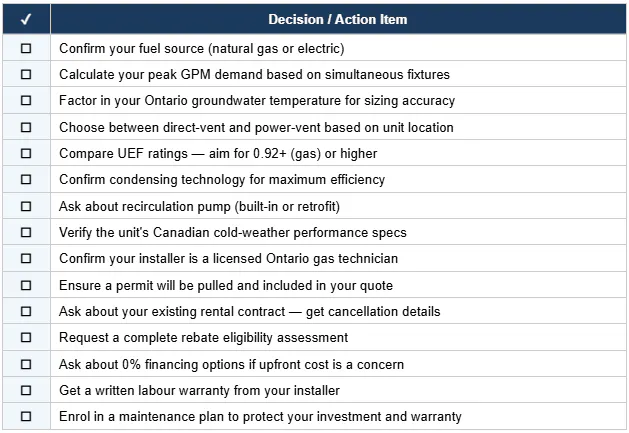
We've guided thousands of Ontario homeowners through this exact process — from the GTA and Hamilton to Ottawa, London, Waterloo, and Barrie. Here's what you get when you work with us:
- Free in-home assessment — we size your unit, check your gas line and venting, and assess your rebate eligibility before you commit to anything
- Licensed, certified HVAC technicians on every job — no subcontractors
- Transparent, all-in pricing — unit, installation, venting, permit, and old tank removal included
- Rebate application handled entirely by our team — we apply savings directly to your invoice
- 0% financing with $0 down, O.A.C. — get your upgrade today and pay over time
- Rental contract cancellation and tank pickup arranged at no extra charge
- Annual maintenance plans to protect your unit and keep your warranty valid
- 24/7 service and emergency repairs across all of Ontario
How long does a tankless water heater installation take?
Most installations are completed in 3 to 5 hours, including removing the old tank, running new venting, making gas and water connections, and commissioning the unit. Same-day installation is available in most areas we serve.
Can I keep my current rental tank and add a tankless heater?
Technically possible, but rarely the best approach. Running both systems simultaneously is inefficient, and most homeowners find the rental fees no longer worth paying once a tankless unit is installed. We recommend cancelling the rental and replacing fully — we manage the process for you.
What happens if the power goes out — will I have hot water?
No — gas tankless water heaters require electricity for the control board and ignition (typically 120V). During a power outage, the unit will not operate. This is also true of modern high-efficiency furnaces. A generator or battery backup would be needed to maintain hot water during extended outages.
Is a tankless water heater covered by my home insurance?
A properly installed tankless water heater — with a permit and done by a licensed technician — is treated the same as any other home mechanical system for insurance purposes. Work done without a permit or by an unlicensed individual may create coverage issues. This is another reason we always pull permits and use licensed gas technicians.
What if my gas line is too small?
Many Ontario homes have 1/2" gas lines running to older tank heaters. High-output tankless units (typically 150,000–199,000 BTU) require a 3/4" line. If an upgrade is needed, we handle it as part of the installation. We assess your gas line during the free in-home visit and include any required upgrades transparently in your quote.
Now that you know exactly what to look for, the next step is a free in-home visit from one of our HVAC specialists. We'll assess your home's hot water demand, check your gas line and venting, identify every rebate you qualify for, and give you a complete, no-surprise quote — all at no cost and no obligation.
Call 1-888-675-5907 anytime — 24/7 — or request your free assessment online. Constant Home Comfort serves Toronto, the GTA, Hamilton, Ottawa, London, Waterloo, Barrie, and all of Ontario.